Two Belgian Art Nouveau posters share the name Rajah and belong to the same Brussels-based colonial-import house, but were designed two years apart by different artists. Both belong in this archive — they are companion pieces in the collector literature, the most reproduced examples of Belle Époque coffee and tea advertising in Belgium, and a useful pair for thinking about how the orientalist commercial register of the 1890s actually worked.
The brand
Rajah was a small Belgian colonial-import company that sold both coffee and tea between roughly 1895 and 1914. The firm never grew large enough to leave a substantial commercial archive: no surviving roaster records are firmly attributed to the brand, no internal catalog has been recovered, and the address books of the period place its Brussels warehouse on or near the Boulevard Anspach without confirming exactly which storefront sold the goods. What survived the company is what survives most small Belle Époque colonial-import houses: a handful of posters, a small trade-card series, and a press notice or two.
The posters are why we still remember the brand. The poster outlived the product.
The 1897 tea poster — Henri Meunier
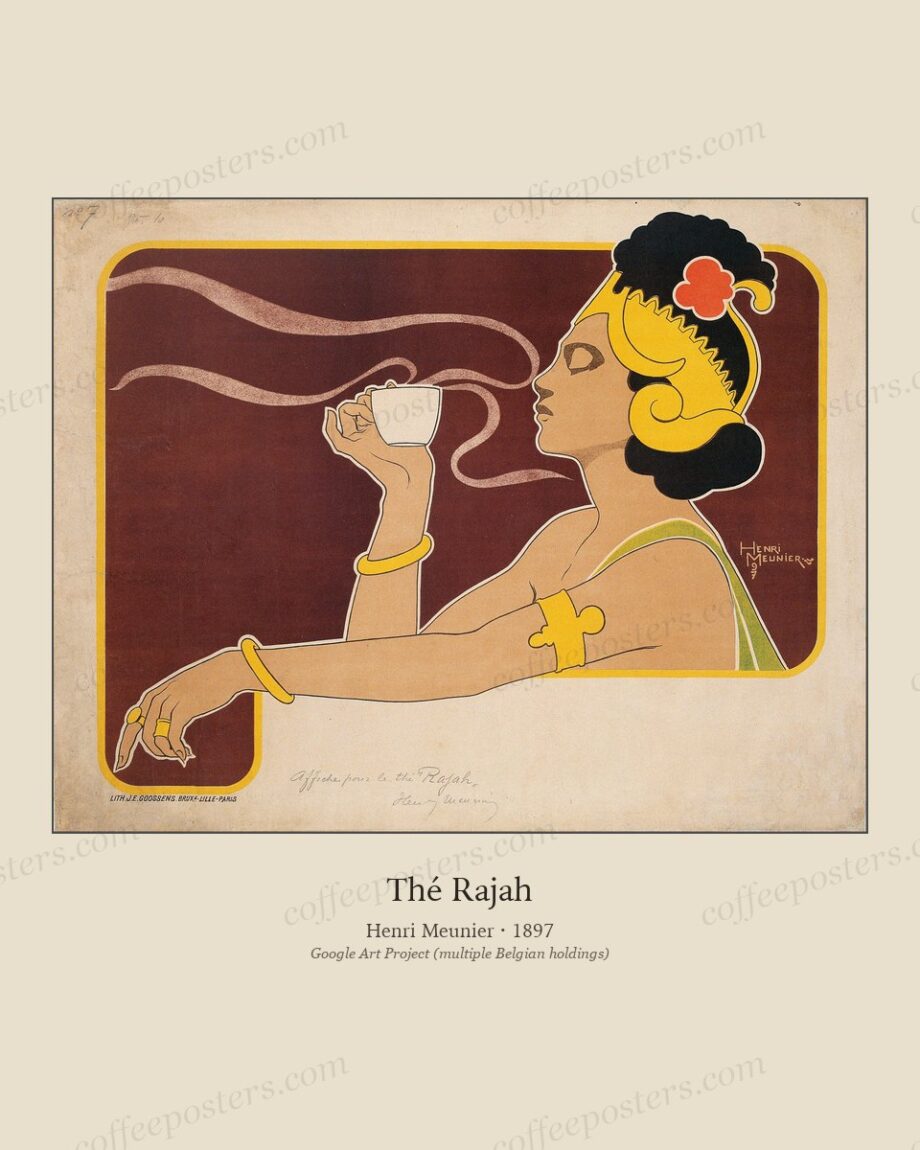
In 1897 the Brussels chromolithographer Henri Meunier (Belgian, 1873–1922) — not to be confused with his uncle Constantin Meunier the sculptor — designed Thé Rajah, a poster for the brand’s tea side. The composition shows a young woman in profile, blowing on a steaming cup; the cup releases a curling ribbon of steam that doubles as the ornamental top of the composition. The palette is cooler than Privat-Livemont’s later coffee poster: amber, ivory, a touch of carmine in the lips and the cup’s interior.
Meunier’s work for the brand sits inside his broader 1897 output, which included three other commercial posters that year and a substantial run of bookplate and program design. He was twenty-four years old when he made the Rajah piece. The Goffin print workshop in Brussels handled the chromolithographic separation.
The 1898–1899 coffee poster — Privat-Livemont
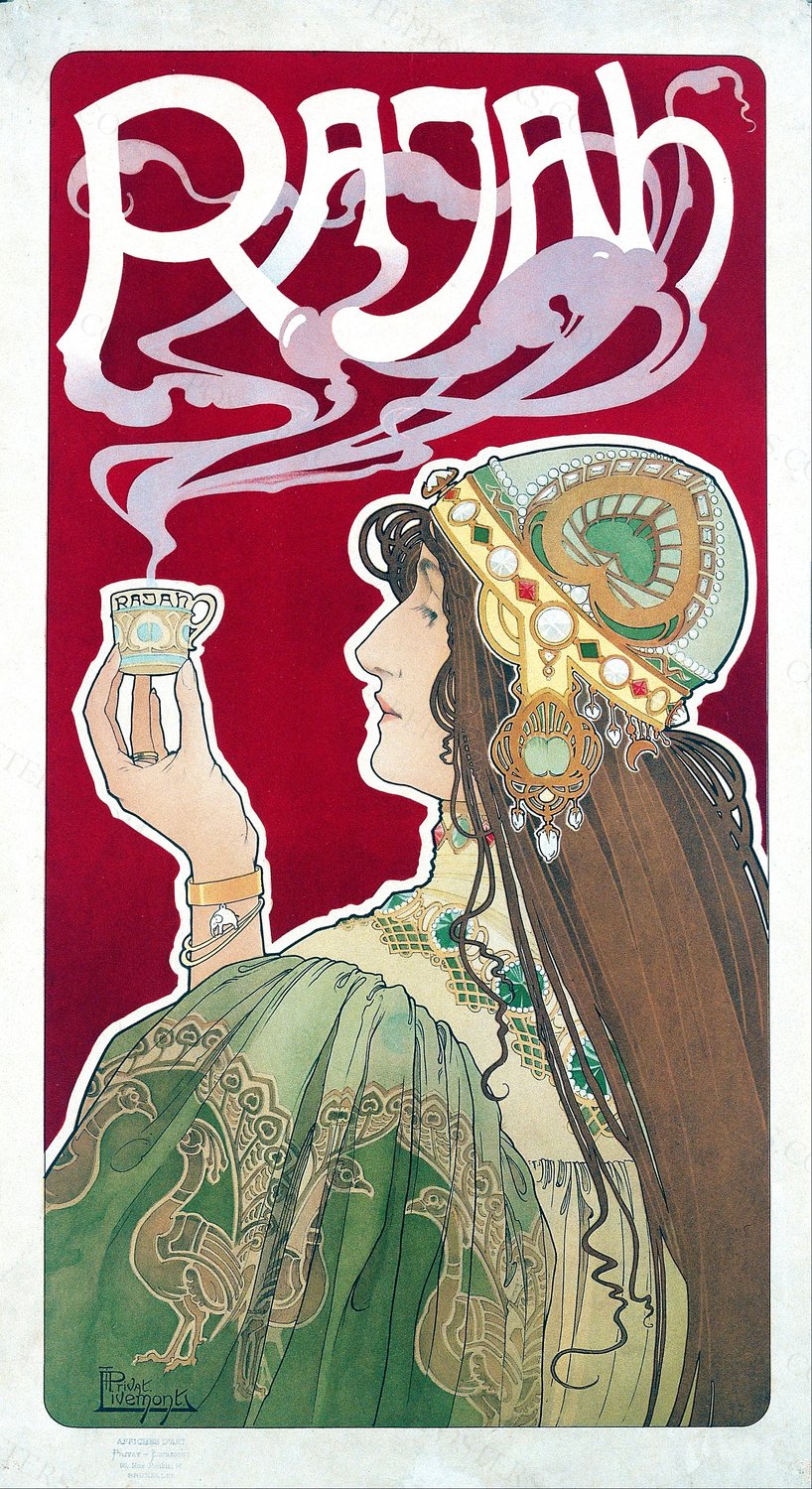
Two years later, the brand commissioned the more prominent Henri Privat-Livemont (Belgian, 1861–1936) for the coffee side. Privat-Livemont was at the height of his commercial-poster career — already established as Brussels’s leading designer of large-format Art Nouveau advertising, with a portfolio that included Absinthe Robette, Cacao Van Houten, and Bec Auer. He charged accordingly.
The result — known simply as Rajah — shows a seated turbaned figure against the dense ornamental border typical of Privat-Livemont’s mature work. The figure holds a stylized cup; the ornamental flora at the figure’s right is the kind of half-invented Eastern motif that ran through European commercial design between 1890 and 1914. Original prints ran roughly 100 × 50 cm at full scale and were printed at the Goffin workshop in Brussels — the same workshop Meunier had used two years earlier for the tea piece. Both posters used the same lithographic press.
What makes them companion pieces
Same brand. Same Brussels print culture. Same two-year window. Same Goffin workshop. Same orientalist commercial register that ran through European coffee, tea, and tobacco advertising between roughly 1890 and 1914.
The two posters operate as a pair in the collector literature on the period: when Belle Époque coffee advertising is treated as a coherent body of work — by the major poster monographs of the 1980s and 1990s, by the Bibliothèque nationale’s holdings catalogs, by the auction-house specialist literature — both Rajahs are usually cited together as a single brand identity expressed by two different designers. The mature Privat-Livemont reads as the dominant piece because it is larger, later, and by the more famous artist; the early Meunier reads as the more elegant of the two, with a tighter composition and a clearer single subject.
On the orientalist framing. We name what these images are. They are European commercial art borrowing an exoticist register to sell beans and leaves grown in territories under European colonial control. The framing belongs to its century. The objects depicted — the turban, the jewel palette, the ornamental flora — are studio inventions intended to signify elsewhere for a Brussels buyer. We include both pieces because the visual record is real and the iconography is part of the history; we don’t romanticize it.
Why they still appear on café walls in 2026
Belle Époque coffee posters are the visual backbone of what people now call “vintage coffee aesthetic.” When a specialty café in Melbourne or a third-wave roastery in Brooklyn picks vintage commercial art for the wall, this is the period and this is the register they almost always pick. The Privat-Livemont and Meunier Rajahs are among the most recognizable and most-reproduced examples.
Why they sit so comfortably next to mid-century furniture and contemporary specialty-coffee interiors is the same answer for both pieces: their palette, ornament, and figure are stylized rather than literal. They were designed to read as commercial signage at a distance and as decorative print at close range. That dual reading is what makes them work on a café wall a hundred and twenty-five years later.
In the archive
- CA-001 — Privat-Livemont, Rajah, 1898–1899 — the coffee Rajah; the hero piece of this archive.
- CA-009 — Henri Meunier, Thé Rajah, 1897 — the tea Rajah; the companion piece.
Both pieces are sourced from the Google Cultural Institute’s maximum-zoom scans of original prints held in Belgian institutional collections. Each is prepared in three print sizes selected for the piece’s resolution.