Historical context
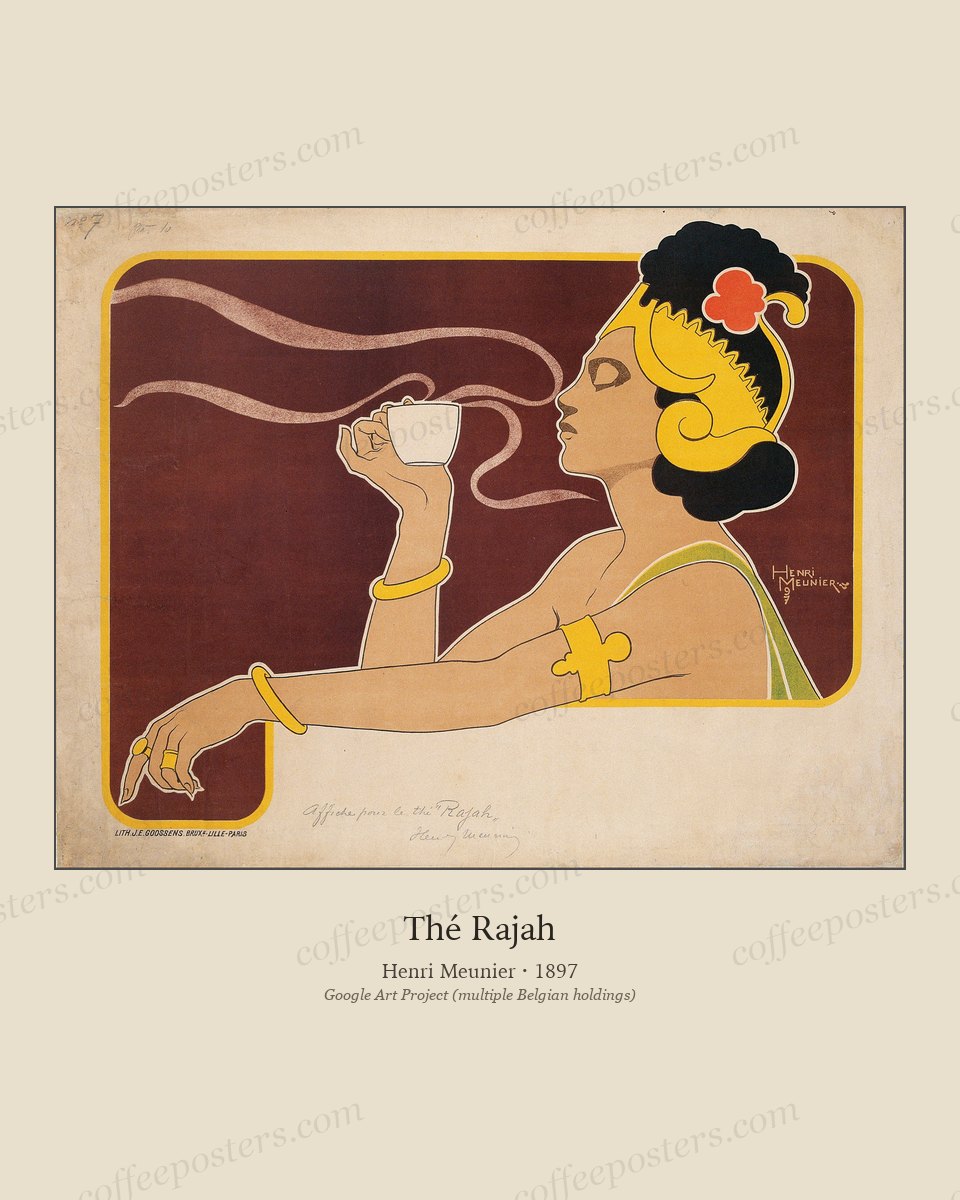
Henri Meunier (Belgian, 1873–1922) is the second Meunier in the Belle Époque — not to be confused with his uncle Constantin Meunier the sculptor. Henri designed posters for Brussels printing houses in the 1890s, and the Rajah brand — a Belgian colonial-import company that sold both coffee and tea — commissioned posters from him and from Privat-Livemont in adjacent years.
This is the 1897 Thé Rajah — the tea side of the brand. Privat-Livemont’s Rajah coffee poster (the archive’s hero piece, CA-001) was designed two years later. The two pieces sit side by side in collector literature on the period and they ran on the same orientalist commercial iconography — the seated turbaned figure, jewel palette, geometrical border.
Technically the piece is a chromolithograph in the standard Belle Époque Brussels practice: multiple registered stones, color separations drawn by hand, edition size in the low thousands. Meunier’s palette is cooler than Privat-Livemont’s — more amber and ivory, less of the Privat-Livemont jewel reds. The geometrical border carries the same orientalist ornamentation.
The file is a 3821 × 2973 px Google Cultural Institute scan at maximum-zoom level. At native scale it prints at 12 × 10 inches; it carries to 20 × 16 inches with care. The composition rewards the larger hang.
Catalog
| Artist | Henri Meunier Belgian, 1873–1922 |
|---|---|
| Title | Thé Rajah |
| Year | 1897 |
| Medium | Chromolithograph on paper |
| Original size | ≈ 60 × 80 cm |
| Holding | Google Art Project (multiple Belgian holdings) |
| License | Public Domain |
| Archive № | CA-009 |
Print specifications
Shelf or kitchen scale. Cream mat, slim oak frame. Pairs well with CA-001 (the Privat-Livemont coffee Rajah) at matched dimensions.
The size at which Meunier’s ornamental border reads correctly. Hang with the Privat-Livemont Rajah on an adjacent wall.
Pushable for a feature wall. At this scale the lithographic stipple becomes visible at close inspection; comfortable from across a room.
Source statement
Digital source: Google Cultural Institute maximum-zoom scan, accessed via Wikimedia Commons. Public Domain.
Original work: Henri Meunier (1873–1922), Thé Rajah, chromolithograph, 1897. Printed Brussels.
Restoration notes. Mild contrast preservation; color balance held to the Google Cultural Institute scan. No retouching applied to the figure or border.