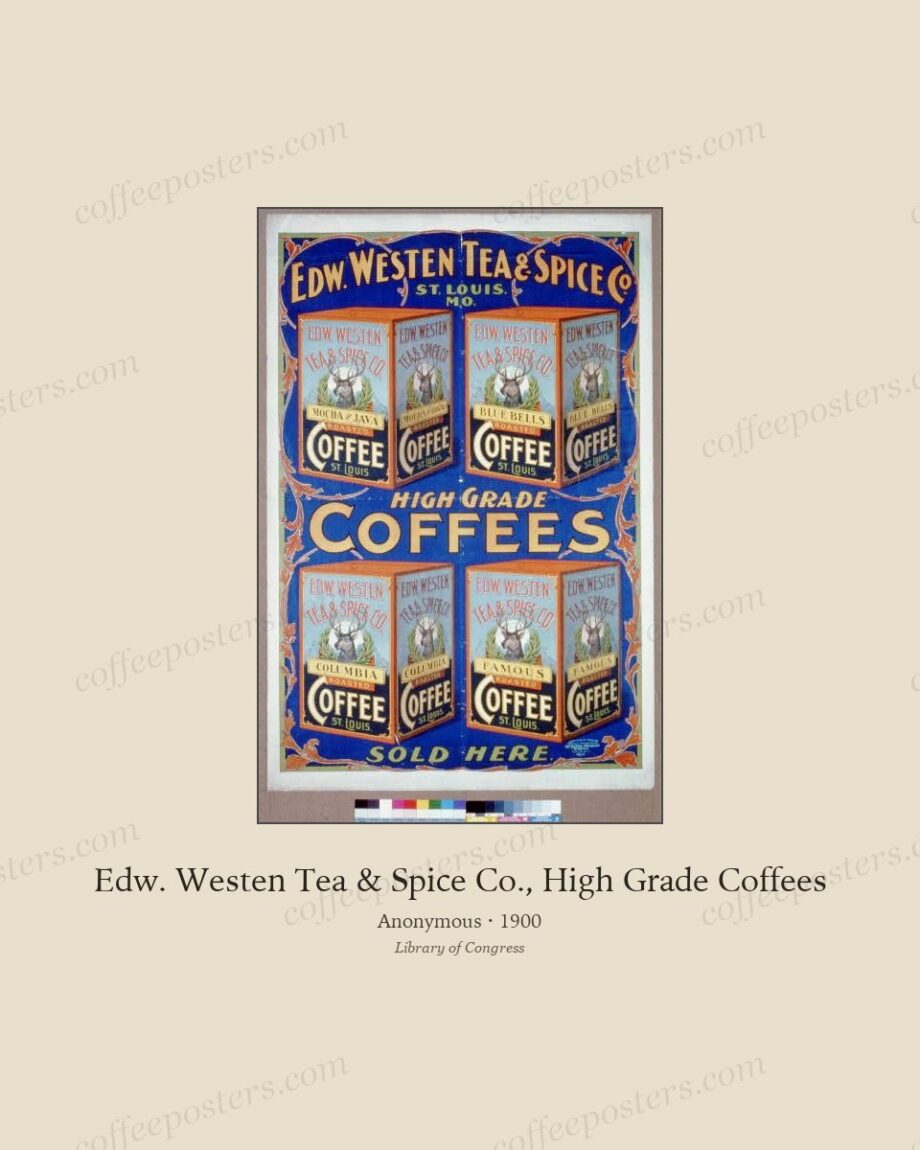
TL;DR — Most Belle Époque coffee brands are remembered, if at all, only by their posters. Small colonial-import houses across Belgium, France, and Germany — the Rajah house in Brussels, countless café-and-chicory firms — commissioned striking advertising, then vanished in a low-margin trade battered by two world wars and the Depression. The poster, printed durably on good stock, outlived the company that paid for it.
By Coffee Posters · Published August 2026
The poster outlived the firm
The Belgian Rajah house is the pattern case. It sold both coffee and tea from around 1895 to 1914, commissioned two of the finest posters of the era — Meunier’s 1897 Thé Rajah and Privat-Livemont’s 1898–1899 coffee Rajah — and then left almost no corporate trace: no surviving roaster records firmly attributed to it, no internal catalogue, only an address near the Boulevard Anspach in Brussels. What we know of the brand is what survives of most small houses of the period: a few posters, a short trade-card series, a press notice or two.
This is the rule, not the exception. The names on Belle Époque coffee posters — small importers, roasters, and café suppliers — are mostly firms that produced a handful of memorable advertisements and then disappeared from the record.
Why so many disappeared
Colonial-import coffee was a crowded, low-margin trade with low barriers to entry, so firms proliferated and failed constantly, merged, or were absorbed by larger grocers. Then came the shocks: the First World War disrupted the colonial supply chains and the European retail market; the 1920s brought instability; and the Depression after 1929 finished many of the survivors.
The advertising outlasted all of it for a simple physical reason. A Belle Époque poster was printed in durable chromolithography on heavyweight coated stock — material designed to survive weeks of pasting and weather. Framed and kept, those sheets aged far better than the fragile paper record of the businesses that ordered them.
Reading a forgotten brand
A surviving poster is often the fullest legible trace of a vanished firm: its name, its market (coffee, or coffee and tea, or coffee and chicory), the workshop that printed it, sometimes its city address. That makes each one a small primary source in commercial history as much as a decorative object — a fragment of a business that would otherwise be entirely lost.
Why they are worth hanging
The forgotten-brand poster carries a particular appeal: it is genuinely rare, genuinely old, and genuinely mysterious, with a story that is mostly gaps. Unlike a famous image reproduced a thousand times, it feels like a discovery — which, in a specialty café or a serious collection, is exactly the point.
In the archive: view the featured piece.
Frequently asked questions
Why are so many old coffee brands forgotten?
They were small colonial-import houses in a crowded, low-margin trade that merged or failed, then were finished by the world wars and the Depression; only their durable lithographic posters survived.
What can a poster tell us about a vanished brand?
Often the only legible trace left: its name, its market, the printing workshop, sometimes its city address — making the poster a primary source in commercial history.
Are forgotten-brand posters valuable?
They can be, precisely because they are rare and mysterious; as wall pieces they carry a discovery quality that famous, much-reproduced images do not.
Further reading
- How chromolithography made the coffee poster possible
- Privat-Livemont and the Brussels print culture
- Chéret, Cappiello, and the French poster tradition
Coffee Posters curates, restores, and reformats public-domain coffee visuals for archival-quality printing. Browse the archive · About.