TL;DR — The French coffee poster has two fathers. Jules Chéret (1836–1932) invented the modern colour poster in the 1870s and filled Paris with joyous, crowded lithographs; Leonetto Cappiello (1875–1942) stripped it back around 1900 to a single shocking figure on a black ground and made it sell. Every French coffee, chicory, and café poster of 1875–1930 sits somewhere on the line between the two.
By Coffee Posters · Published July 2026
Chéret: the man who put colour on the wall
Jules Chéret is the reason the colour poster exists as a mass medium. He learned lithography as an apprentice in Paris, spent seven years in London (1859–1866) studying English colour printing and the big commercial presses, and came back to Paris in 1866 to open his own workshop with English Hoe machinery. His breakthrough was economic as much as artistic: a three-stone colour lithographic method — typically a red, a blue, and a yellow stone, over-printed and stippled with the créchage technique — that produced a full, luminous range of colour cheaply enough to paper a city.
His visual signature was the Chérette: a laughing, weightless young woman in movement, skirts flying, that he used to advertise everything from Saxoléine lamp oil to the Folies-Bergère. For coffee, chicory, and café clients the register sold pleasure and sociability — the drink as part of the Parisian good time rather than a product with specifications. By the 1890s Chéret was producing over a thousand designs and had trained, directly or by example, most of the next generation.
Why Chéret matters for coffee
Chéret proved that a drink could be sold on mood, at scale, in colour, on the street. Without his colour lithography the entire Belle Époque coffee poster — Privat-Livemont’s Rajah included — is technically impossible; the same press logic underlies the Brussels and Paris coffee output. The full technical story is set out in our note on how chromolithography made the coffee poster possible.
Cappiello: one figure, one idea
Leonetto Cappiello, Italian-born and Paris-based, is the other pole. He began as a caricaturist, and around 1900–1903 he arrived at the insight that reinvented advertising: a poster glimpsed for two seconds from a moving tram or omnibus needs exactly one idea. So he emptied the frame. Where Chéret crowded it with figures, Cappiello threw a single arresting character — often in an impossible colour — against a flat, dark, usually black ground, so the image could not be missed and could not be forgotten.
The figure did not have to depict the product; it had to become the brand’s memory hook — the green devil for Maurin Quina, the horse for Cinzano. Applied to coffee and café clients, the method turns an advertisement into a graphic mark rather than a depicted scene. His Café Martin poster is a textbook case: one luminous figure, black ground, instant recall.
The two traditions side by side
Almost every French coffee poster of the period leans toward one pole or the other, and knowing which tells you roughly when it was made and what it was trying to do.
After Cappiello
Cappiello’s black-ground, single-figure method dominated French advertising until the mid-1920s, when the Art Deco generation — A.M. Cassandre above all — pushed it further toward geometry and integrated lettering. But the underlying principle, one poster / one idea, is still the basis of brand advertising today, and it started on the café-lined boulevards of Paris.
How to place a French coffee poster at a glance:
- Crowded, light, in motion, warm ground — Chéret lineage, earlier (1875–1900).
- One bold figure, flat black ground, high contrast — Cappiello lineage, later (1900–1925).
- Hard geometry, integrated type, airbrushed tone — the Art Deco generation after 1925.
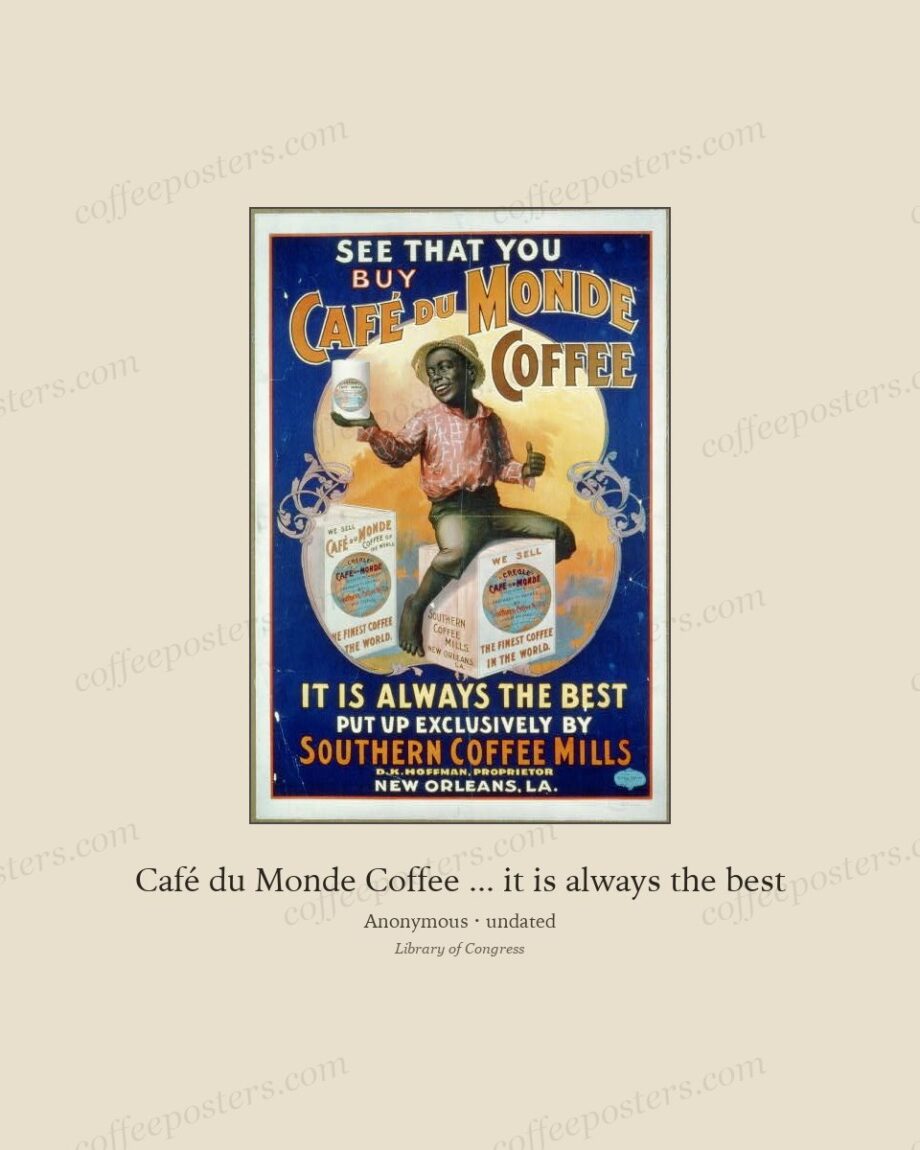
In the archive: Cappiello’s Café Martin and the French coffee piece Café du Monde.
Frequently asked questions
Who invented the modern colour poster?
Jules Chéret, working in Paris from 1866 with a three-stone colour lithographic method that made large, bright posters cheap enough to print at city scale.
What was Cappiello’s innovation?
Reducing the poster to a single arresting figure on a flat black ground — one idea, readable in two seconds — which is the basis of the modern advertising poster.
How can I tell a Chéret-style poster from a Cappiello-style one?
Chéret is crowded, light, and in motion on a warm ground; Cappiello is a single high-contrast figure on a dark ground. The first tends to be earlier (1875–1900), the second later (1900–1925).
Further reading
- How chromolithography made the coffee poster possible
- Privat-Livemont and the Brussels print culture
- Chéret, Cappiello, and the French poster tradition
Coffee Posters curates, restores, and reformats public-domain coffee visuals for archival-quality printing. Browse the archive · About.