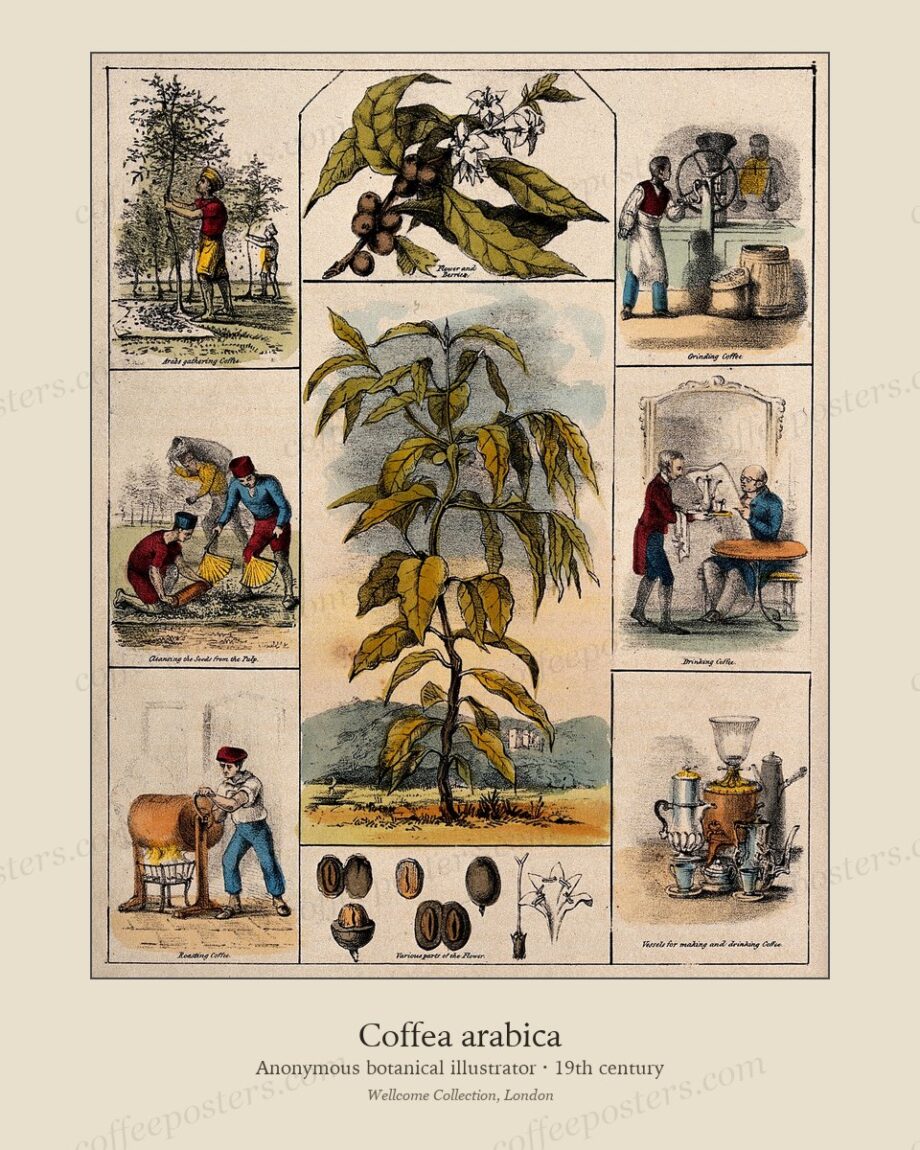
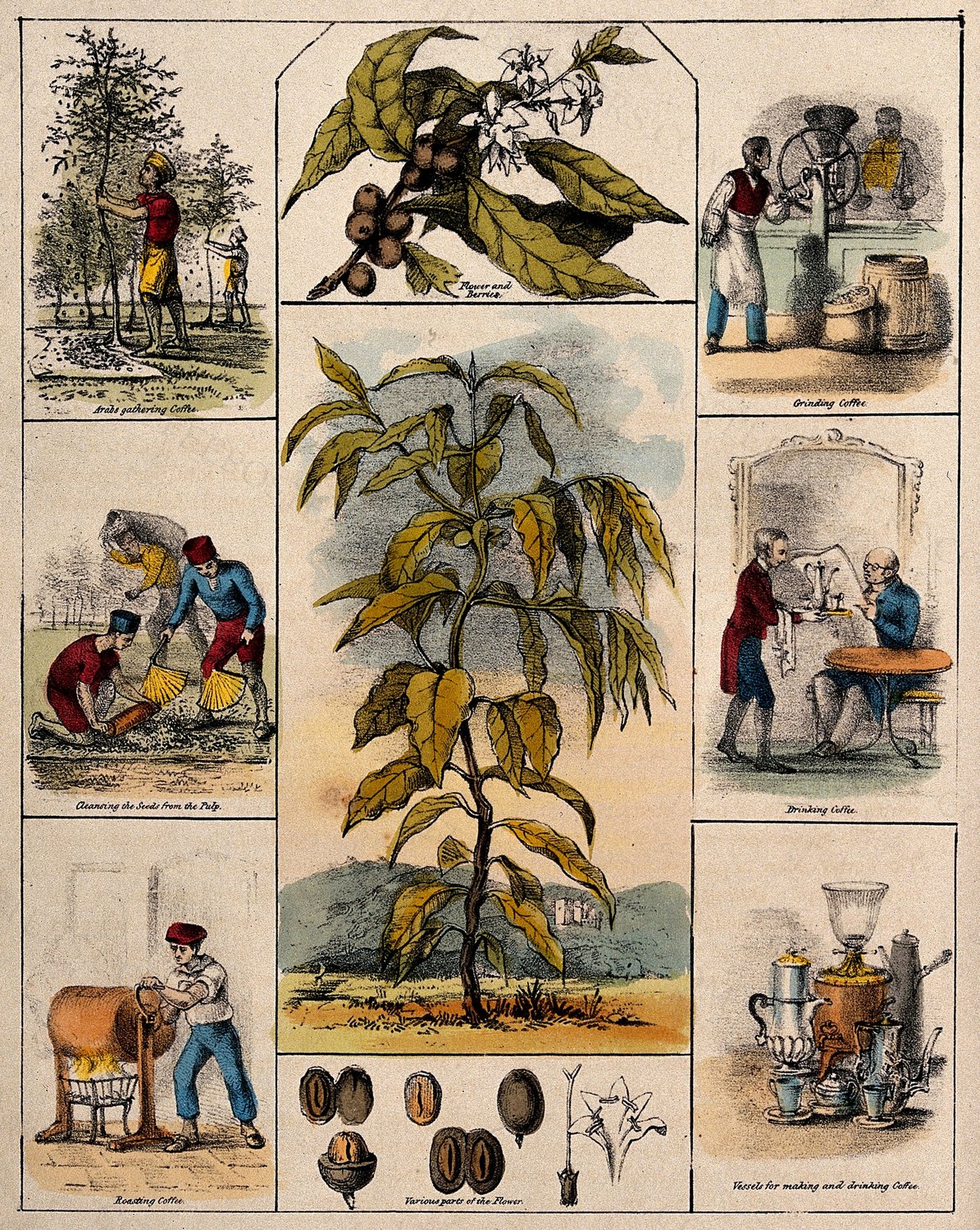
The botanical plate of Coffea arabica that hangs on a roastery wall is a specific genre of 19th-century scientific illustration. It was made by named botanical artists for medical and pharmacological reference works, printed by hand-coloured engraving or lithography, and is one of the few coffee-related visual genres where the artist’s name is usually known. This is a tour of where the plate comes from.
The genre
Botanical illustration of medicinally-relevant plants developed as a working scientific tradition in the late 17th century and matured through the 18th and 19th into a recognisable visual format. Each plate showed the whole plant in flowering form alongside enlarged details of the flower, fruit, seed, and cross-sectioned bean. The illustration was usually accompanied by a one- or two-page descriptive text in a reference compendium.
For coffee specifically, the production peak runs from roughly 1820 to 1890. The early plates appear in pharmacological reference works (where coffee was classified as a mild medicinal stimulant). Mid-century plates move into popular natural-history illustration for educated household reference. Late-century plates are in horticultural and agricultural compendia produced for the global colonial-trade market.
How the plates were made
Two main techniques. Before 1830, mostly hand-coloured engraving on copper plate: a botanical artist draws the plant; an engraver translates the drawing onto a copper plate as line work; the plate is printed in black ink onto paper; then a colourist (usually a woman, working from the original drawing as reference) paints the colours by hand onto each printed sheet. The result is a black-line engraving overlaid with hand-painted watercolour.
After 1830, the workflow shifts to chromolithography for high-end work and lithography with hand-colouring for everyday work. Chromolithography uses a separate limestone plate for each colour and the colour is printed, not painted — faster, more uniform, but the hand quality of the early hand-coloured engravings is lost.
The most prized period for botanical coffee plates is roughly 1830 to 1860 — the brief window when colour printing was good enough to produce richly tonal images but hand-colouring of engravings was still common enough that the highest-end editions used it. After 1880 most botanical plates are pure chromolithography.
The named artists
Botanical illustration is one of the few areas of 19th-century commercial print where the artist is consistently credited in the published edition. Coffee-relevant figures:
- Pierre-Joseph Redouté (1759–1840) — French; the most famous botanical illustrator of the period. His coffee plate appears in Les Roses and several pharmacological compendia.
- Walter Hood Fitch (1817–1892) — Scottish; produced over ten thousand botanical plates including coffee material for Curtis’s Botanical Magazine and the Kew Gardens publications.
- Franz Eugen Köhler (1858–1893) — German; the Coffea arabica plate in his Medizinal-Pflanzen (1890s) is one of the most-reproduced coffee botanical illustrations on the modern poster market.
- Anonymous botanical illustrators — most coffee plates in colonial agricultural compendia are unsigned. The plate held by the Wellcome Collection in London (which is the source for one of the pieces in this archive) is in this category — high quality, hand-coloured engraving, undated, illustrator unrecorded.
What to look for at close range
Three things distinguish a real 19th-century botanical plate from a modern reproduction:
The line work. An engraved or lithographed botanical line drawing has a slight variation in line weight that comes from the engraver’s hand pressure on the copper or stone. A modern reproduction’s lines are perfectly uniform.
The hand colouring. Where hand colouring is present (most pre-1880 plates), small variations between adjacent leaves or flower segments are normal — the colourist works one element at a time. Modern reproductions are completely uniform.
The paper. Period botanical plates are printed on heavyweight rag paper, often with a visible plate mark (the impression of the copper plate’s edge on the paper). The modern reproduction usually loses the plate mark.
What works in a coffee interior
Botanical plates work strongest in roastery showrooms, near the green-bean station. They also work in home espresso corners, where they sit comfortably next to domestic-genre prints at small scale. They do not work as the centrepiece of a cafe back wall — the scale and graphic register are too quiet to anchor a busy interior.