Historical context
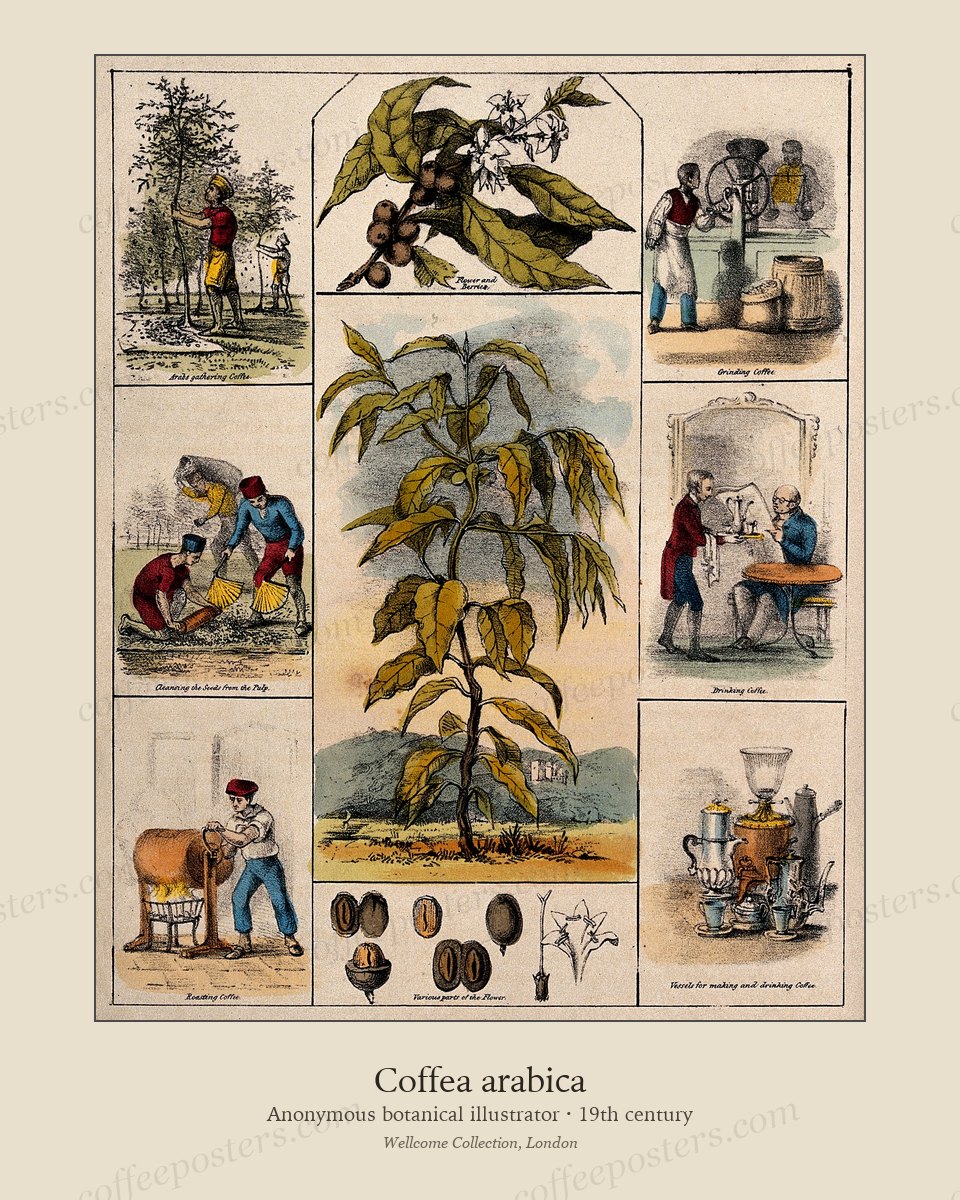
This plate of Coffea arabica — flowering branch at center, isolated bloom and fruit cross-section at the margins — follows the convention of 19th-century scientific botanical illustration: a single sheet that gives the reader everything needed to identify the species in flower, in fruit, and in seed. The species itself was described and named by Linnaeus in 1753; by the time this plate was drawn the form had been stable for a century.
The hand of the illustrator is anonymous in our source. Sheets of this kind were typically produced by botanical institutions or commercial publishers working from cultivated specimens in European hothouses — Kew in London, the Jardin des Plantes in Paris, the Hortus Botanicus in Leiden. The aesthetic register is identical across the genre regardless of authorship.
Technically this is a hand-colored engraving: an intaglio plate inked, wiped, and pressed onto rag paper, then washed with watercolor by hand. The line work is the engraver’s; the chromatic accuracy is the colorist’s. The two were rarely the same person.
The composition follows the European botanical-plate standard set by Pierre-Joseph Redouté and the Tournefort and Linnaean engravers before him: a primary specimen at scale, isolated details at margin, ground left clean. The convention reads as quiet because it was designed to be read alongside taxonomic text, not on a wall.
Source file is 2480 × 3113 px at 300 DPI from the Wellcome Collection’s open-access program. At native scale it prints at 8 × 10 inches without intervention. The composition reads well at 11 × 14 inches with a wide mat; larger sizes start to expose the watercolor wash.
Catalog
| Artist | Anonymous botanical illustrator |
|---|---|
| Title | Coffea arabica — Flower & Fruit, Segmented |
| Year | 19th century |
| Medium | Hand-colored engraving on paper |
| Original size | ≈ 26 × 21 cm (plate) |
| Holding | Wellcome Collection, London |
| License | CC BY 4.0 · attribution: Wellcome Collection |
| Archive № | CA-003 |
Print specifications
The classic botanical-plate hang. Cream or off-white mat, slim oak or walnut frame. Works as a pair or set of three with companion species.
The sweet spot for a single-piece hang on a kitchen or coffee-bar wall. Generous mat (6 cm) lets the composition breathe.
Pushable for a feature wall, but at this size the watercolor washes flatten. We’d choose this for an apothecary-style hang where the institutional feel is the point.
Source statement
Digital source: Wellcome Collection, London, open-access program, CC BY 4.0. The original plate is anonymous in Wellcome’s cataloging.
Original work: 19th-century botanical illustrator (anonymous), Coffea arabica, hand-colored engraving.
Restoration notes. Conservative balance: paper warmth preserved, no whitening of the ground. Minor edge cleanup.