Between roughly 1890 and 1920, a small group of mostly Italian-trained painters worked the São Paulo coffee fazendas as their subject matter. The result is the most detailed visual record of the global coffee supply chain at peak production. The paintings are visually rich. They are also, by 2026 standards, documents of a labour system that needs honest framing. This is the short tour.
The setting
By the late 19th century, São Paulo was producing more coffee than the rest of the world combined. The fazenda system — large agricultural estates dedicated to coffee monoculture, originally run on enslaved Black labour (the Brazilian slave trade was abolished only in 1888) and afterwards on a mix of freed-Black labour and Italian immigrant contract labour — reached its peak between 1890 and 1920. The Museu Paulista in São Paulo (the Imperial palace converted to a museum after Brazil became a republic in 1889) became the institutional patron of a painting tradition that documented the fazendas at this exact peak.
The painters
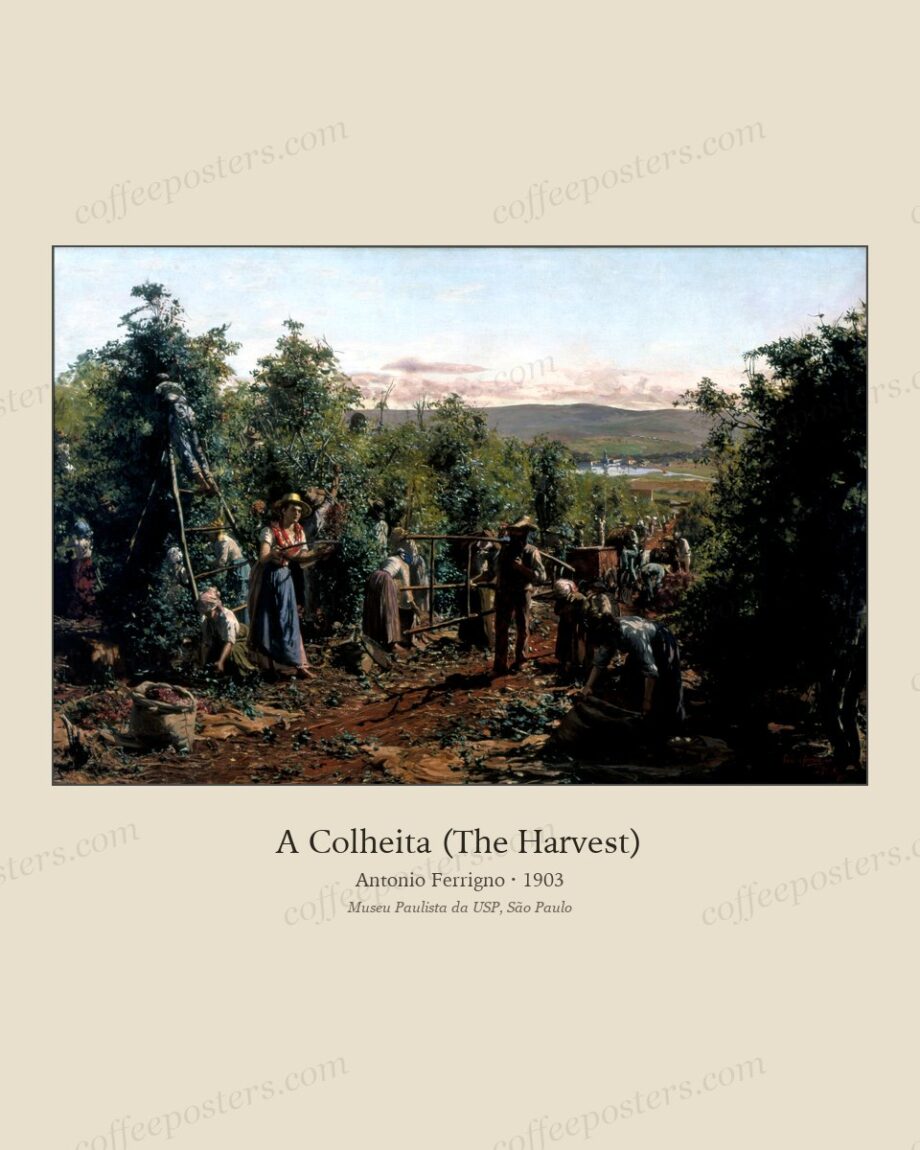
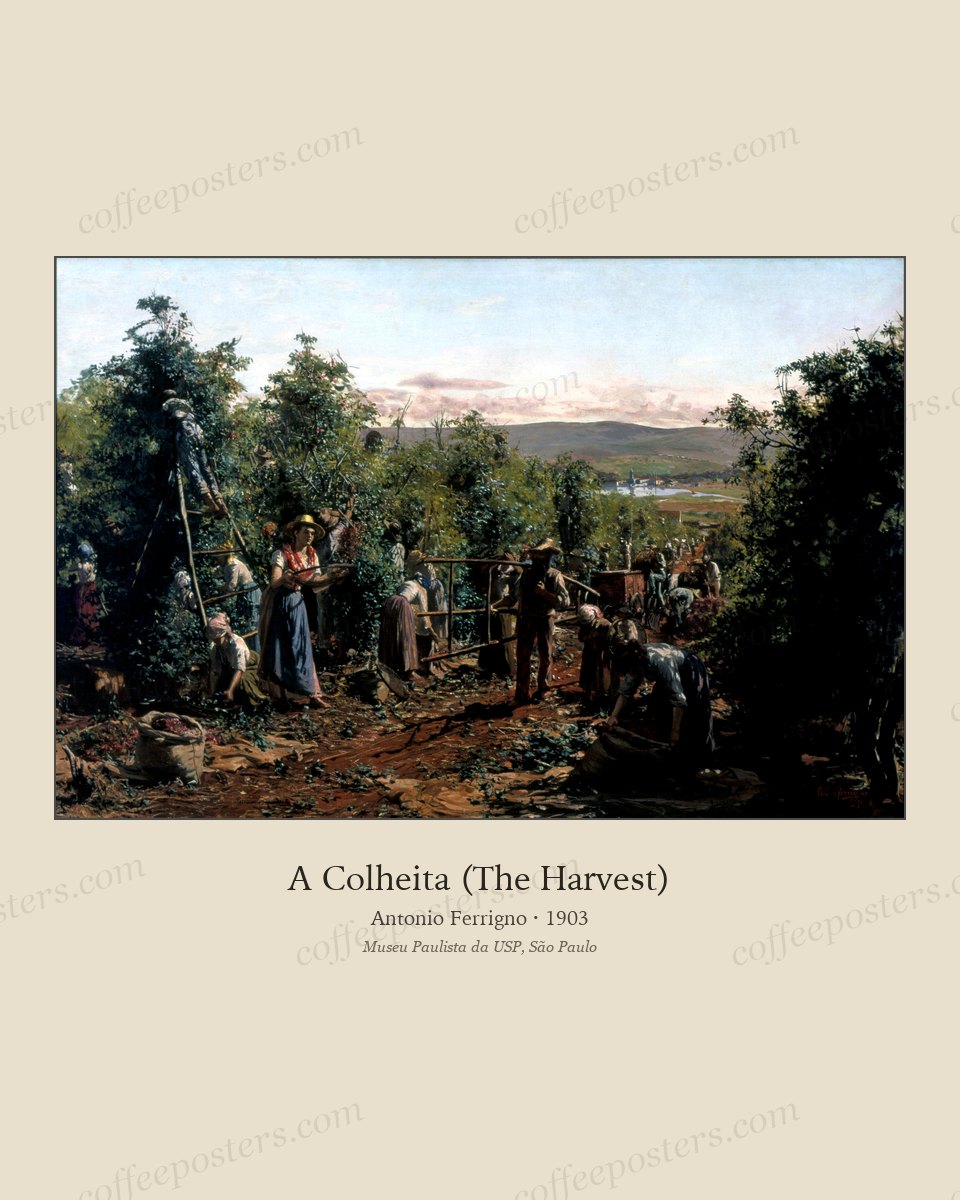
Antonio Ferrigno (1863–1940) trained in Naples and emigrated to São Paulo in 1894. He spent the next two decades painting the fazendas of the São Paulo interior — harvest scenes, processing yards, slave-quarters-turned-immigrant-housing, and the broader plantation landscape. A Colheita (1903) is his canonical harvest painting, held by Museu Paulista. It shows the moment when the ripe coffee cherries are picked and carried in baskets to the central processing yard. The painting is large (roughly 80 by 110 cm in the original canvas) and was painted on the fazenda from direct observation. Ferrigno returned to Italy in 1914 and lived out his life in Naples.
Alfredo Norfini (1867–1944) also trained in Naples and arrived in São Paulo in 1892. His fazenda paintings sit a generation later than Ferrigno’s — the canonical ones are from the late 1910s and early 1920s — and the landscape they depict has shifted: the immigrant labour has become a more visible feature; the processing equipment is more industrial; the railway has reached into the interior. Fazenda da Barra (1920) depicts an 1840s scene, painted from memory and from older photographs, and shows the earlier slave-labour period as Norfini imagined it from eighty years later.
Benedito Calixto (1853–1927) was Brazilian-born and worked the coastal landscapes more than the fazenda interior. He painted some fazenda scenes but is best known for his São Vicente coastal historical paintings; the coffee material is a smaller fraction of his output.
Pedro Américo (1843–1905) was the senior Brazilian academic painter of the era; he produced very little coffee material specifically but his presence at Museu Paulista shaped the institutional tradition that commissioned the later coffee work.
What the paintings show
The strong fazenda paintings — Ferrigno’s A Colheita and Norfini’s Fazenda da Barra are the canonical examples in this archive — share a documentary register. The painters worked from direct observation and from photographs. The landscape, the buildings, the equipment, and the work itself are accurate to the period. The coffee cherries are at the right ripeness; the drying-yard layout is correct; the basket and tool shapes match surviving museum-collection examples.
The labour shown in the paintings is the historically real labour system of the fazenda at that moment. Until 1888 that meant enslaved Black workers. From 1888 onwards, freed Black labour and Italian-immigrant contract labour. The Italian painters in particular were not neutral observers of this transition — they were part of the Italian-immigrant population whose arrival reshaped the labour market.
How we present this material
The paintings are visually important and historically significant. They are also documents of a labour system that included slavery and, after abolition, often-exploitative contract labour. We include them in the archive because the visual document is real; we name what they depict honestly when asked; we do not romanticise the fazenda as “old world charm” or “the romance of coffee.”
In practical terms: if you put one of these on a cafe wall, you are putting up a painting of a São Paulo coffee plantation in the early 20th century. That is what the painting is. It is not a generic vintage scene; it is a specific documentary record of how coffee was produced at the moment when it became a global commodity. If a customer asks about the painting, the honest answer includes the labour history.
What works on a wall
The Ferrigno and Norfini paintings work strongest in roastery interiors where the supply-chain context is the explicit theme of the space. They also work in restaurant dining rooms that handle period material with intent. They are not light decorative pieces; they reward being given visual weight.
Both paintings print well at 16×20 inches and up; below that the figural detail is lost.