The default option for a specialty cafe interior in 2026 is to buy a generic “vintage coffee print” on Etsy, Amazon, or Society6. Most of these prints are designer-drawn imitations of real period work. They look the part at a distance and lose every point of interest up close. This is the case for using actual archival material instead.
The generic-print failure mode
A typical “vintage coffee poster” sold on Etsy or Amazon in 2026 is a digital illustration made in the last five or ten years by a graphic designer working in Illustrator. The designer studied period Belle Époque commercial print, then drew their own version. The result is graphically clean, prints well at any size, and reads as vintage-style at a distance.
It fails at close range. A customer standing two metres away can’t tell the difference. A customer standing thirty centimetres away — the customer waiting for their order at a busy bar, or sitting at the table directly under the print — can. The line work is too even, the colour separations are too clean, the registration is perfect in the way machine print is perfect. There is no hand on the surface.
The customer doesn’t read the print as archival. They read it as graphic design pretending to be archival. The cafe loses the credibility it was trying to buy.
What real archival material does instead
An actual restored chromolithograph from 1899 carries every detail of the original printing process: the slightly mis-registered colour layers, the hand-cut typographic blocks, the paper grain showing through the ink, the small workshop mark in the lower-right margin. At thirty centimetres the print reads as a real object with a real history. At two metres it reads the same way the generic print does — as vintage coffee art. The buyer who notices either reading gets what they came for.
The cafe wall does two jobs at once. To the casual customer, it signals taste. To the customer who actually looks — the one who will come back, who will mention the place to a friend, who matters disproportionately to the bottom line — it signals that the place was put together by someone who cared about the details a customer would notice.
What ‘archival’ actually means
An archival piece, in this archive’s working definition, is an image that meets four conditions:
- Source institution. The original is held by a named museum, library, or archive that catalogues its holdings publicly. Wellcome Collection in London. The Bibliothèque nationale de France. Library of Congress. Rijksmuseum. Museu Paulista at the University of São Paulo. The institution’s name and the original’s catalogue number are part of the piece’s provenance.
- Public-domain status. The original work is in the public domain in the United States. This usually means it was published before 1929; in some cases, the institution has voluntarily released a more recent work under CC0 or CC BY 4.0.
- Restoration without invention. The image has been cleaned of acquired age artefacts (foxing, water stains, edge damage) but not retouched, recoloured, or recomposed. Nothing is added that wasn’t on the original print. If a sky is partly missing, it stays partly missing.
- Three print sizes prepared from the original scan. Not AI-upscaled invention; actual resolution adequate for 8×10, 11×14, and 16×20 inch prints, sized from the institutional master scan.
The four conditions together are what distinguishes archival work from generic vintage print. Anyone selling work without all four is selling a different product.
What works on a specialty cafe wall
The cafe interior that puts archival material to work usually does three things:
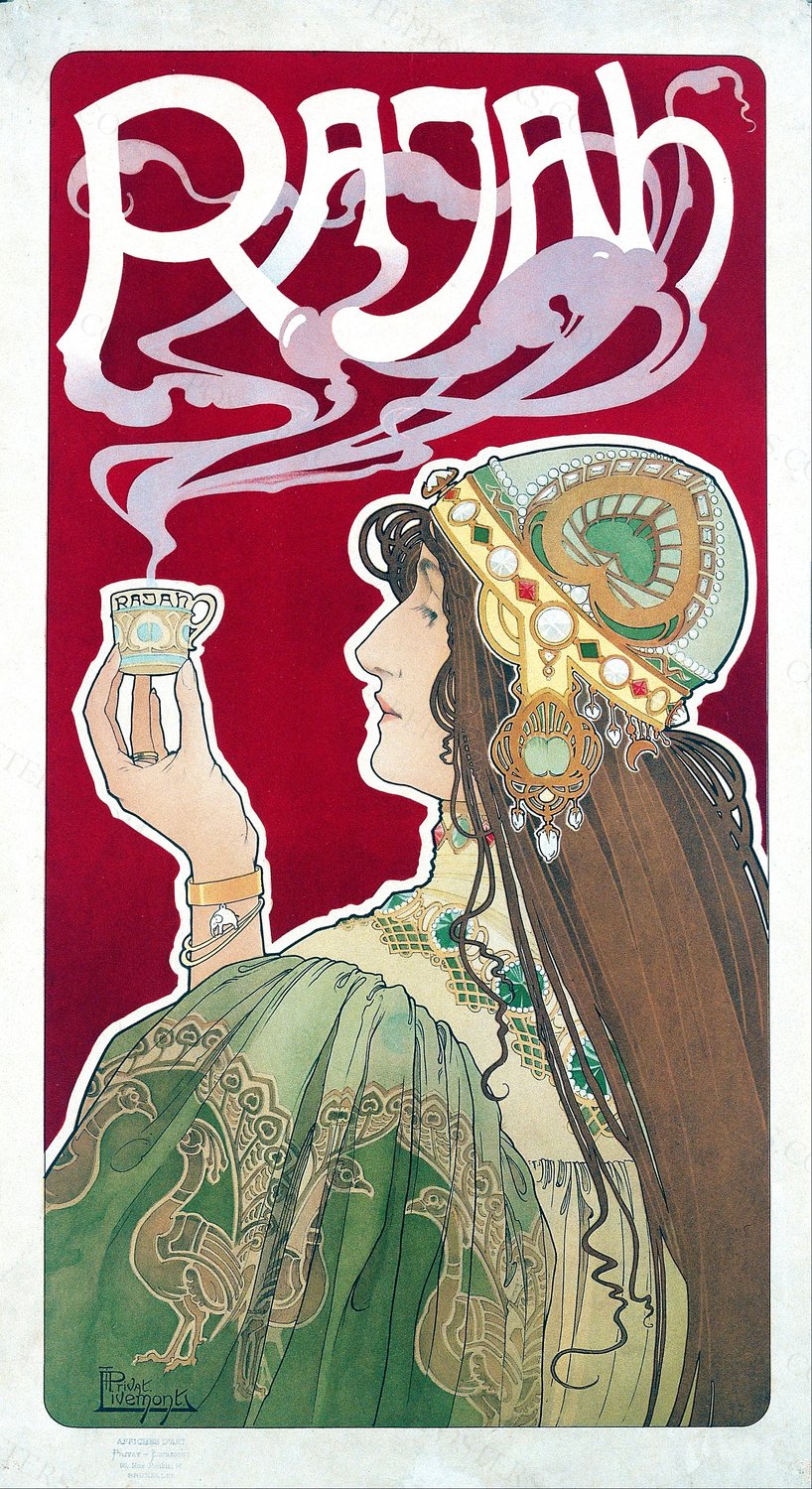
Anchors with a Belle Époque poster. Privat-Livemont’s Rajah, Henri Meunier’s Thé Rajah, or any of the period’s strongest poster compositions, at the largest available print size — usually 16×20 inches at minimum, ideally 20×30 if wall scale allows. This is the piece a customer notices first.
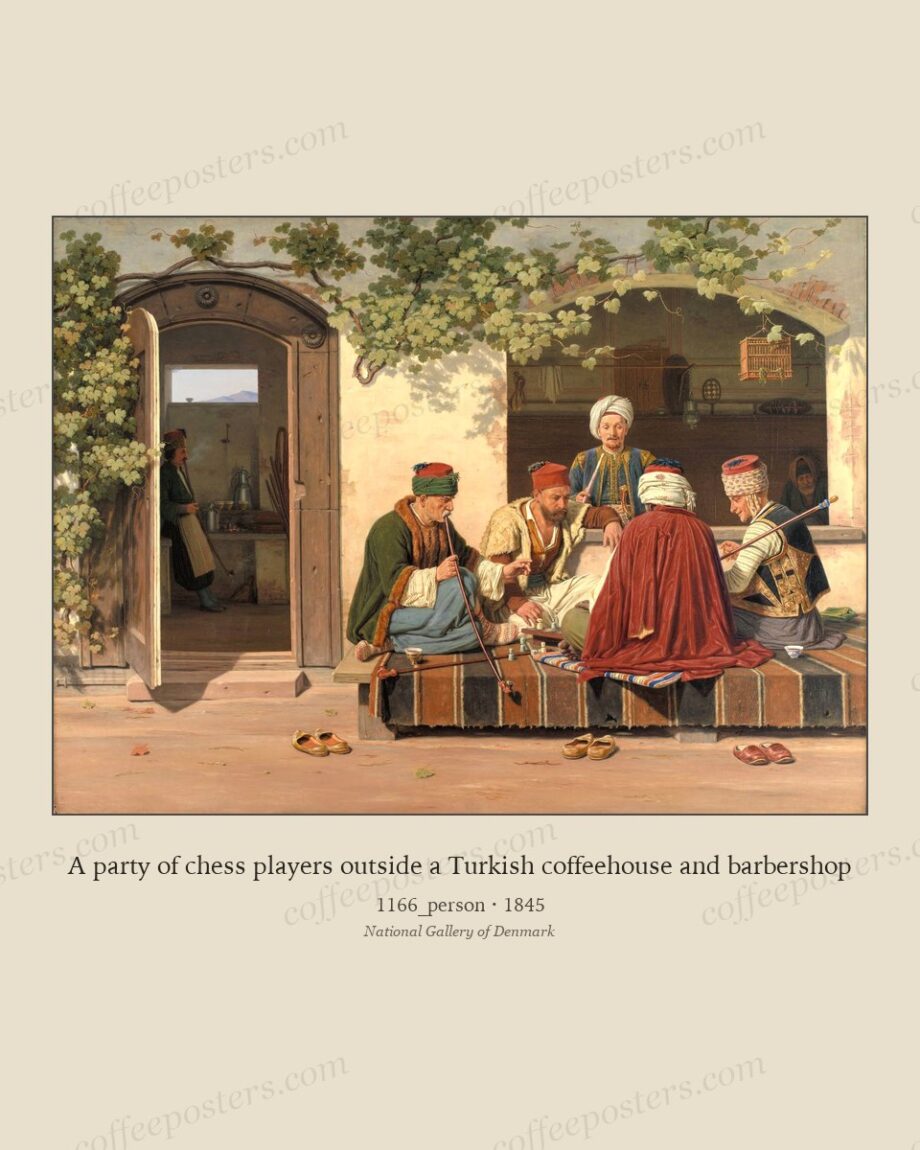
Layers in domestic-genre or cafe-scene work at eye level. Smaller pieces, 8×10 or 11×14 size, hung at the height where a seated customer’s eye lands while waiting for their drink. Albert Anker’s Old Man with Coffee Grinder (1886). The Cairo coffeeshop lithograph. Manet’s Corner of a Café-Concert. These read as narrative; the customer reads one while waiting.
Closes with botanical or plantation work near the bean. The Coffea arabica botanical engraving, or one of the Brazilian fazenda paintings, hung in the line of sight from the order counter to the bean shelf. This is the piece that does the supply-chain storytelling without anyone having to talk about it.
Three to twelve pieces, depending on wall scale. Matched mat colour. Matched frame stock.