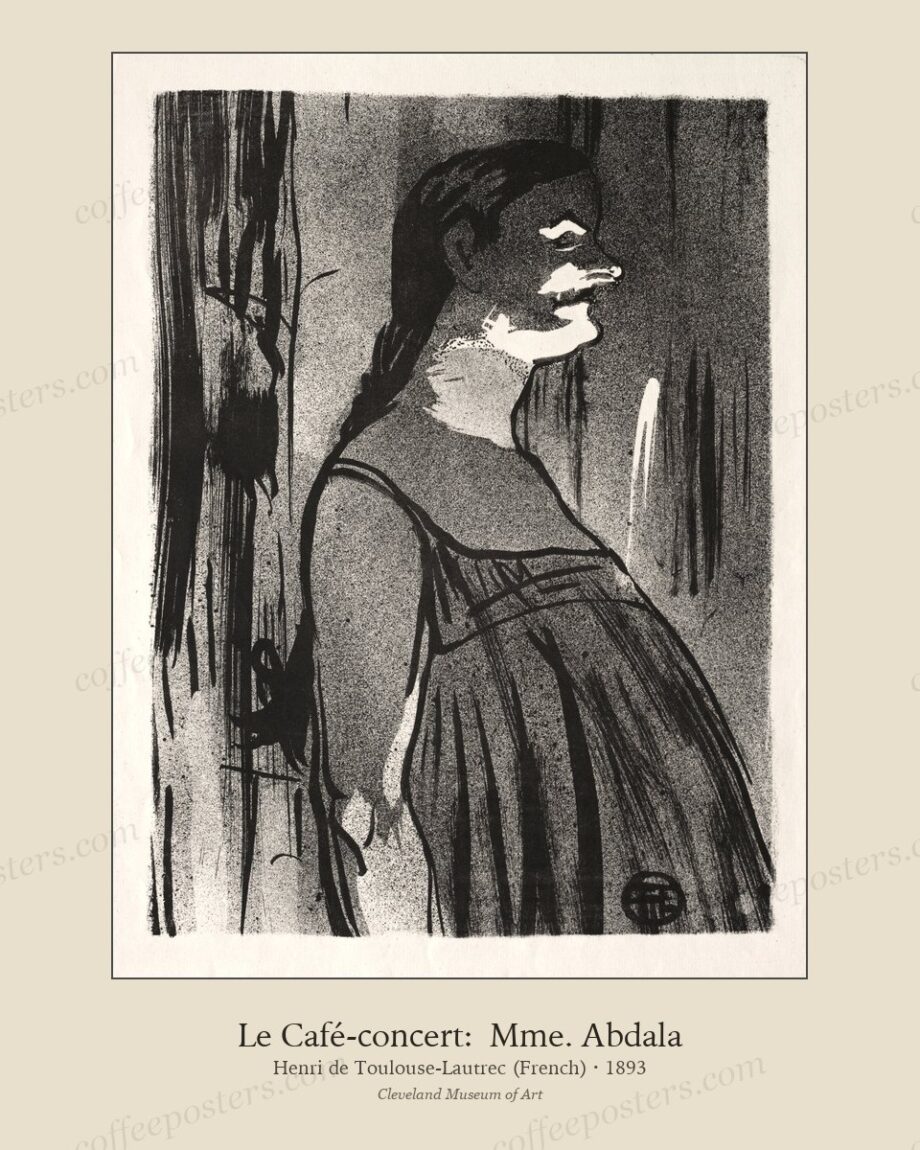
TL;DR — A roastery wall can tell the whole supply chain in five pieces: a botanical plate of the plant, a plantation landscape, a transport or trade image, a roasting scene, and a drinking scene. Sequenced left to right in uniform frames, it turns a blank wall into a bean-to-cup story that says more about your sourcing than a paragraph of copy.
By Coffee Posters · Published August 2026
Five links, five pieces
The coffee supply chain is a natural sequence, and five images cover it cleanly: the plant itself, the place it grows, the journey to market, the roast, and the cup. Each link corresponds to a category in the archive, so the set assembles itself — botanical for the plant, plantation-origin for the farm, a trade or transport image, a roasting engraving, and a drinking scene for the cup.
Five is the right number: enough to read as a deliberate narrative, few enough to hang large and legible in a working roastery where wall space competes with equipment.
Sequence it like a story
Hang the five in supply-chain order, left to right, on a single centre line. A customer waiting for a bag of beans reads the wall as a narrative — exactly the sourcing story a roastery wants to tell. Add a small caption line under each if the space suits it (“Coffea arabica, botanical plate, 19th c.”), and the wall does the work of a provenance leaflet without anyone reading a leaflet.
Keep the frames uniform
The five images come from different centuries and media — a botanical engraving, an oil-painted plantation, a line engraving of a roaster — so a single repeated frame is essential to make them read as one intentional sequence rather than five unrelated prints. Thin matte black or warm oak, one mat colour, equal sizes where possible; let the sequence, not the frames, carry the variety.
Scale for a working space
Roasteries are industrial rooms with high ceilings, machinery noise, and dust. Go large — the pieces need to read across the space and hold their own against a drum roaster — and glaze them properly, because roasting throws fine chaff and oil into the air. Anti-reflective, UV-filtering glazing keeps the prints legible and protected in a demanding environment.
Extending the story
If the wall is long, the five-piece spine extends naturally: add a second botanical variant, a map or trade card, an equipment engraving (a period grinder or roaster), or an origin scene from a specific country you actually source. Keep the left-to-right supply-chain logic and the uniform frames, and the wall scales from five pieces to a dozen without losing its thread.
In the archive: view the featured piece.
Frequently asked questions
How do I show coffee sourcing on a wall?
Sequence five pieces in supply-chain order — plant, plantation, transport, roasting, drinking — in uniform frames on one centre line. It reads as a bean-to-cup story.
How many pieces for a roastery wall?
Five covers the supply chain without crowding; extend to a dozen along the same left-to-right logic if the wall is long.
What glazing for a roastery?
Anti-reflective, UV-filtering glazing — roasting throws chaff and oil into the air, and a working space needs the prints protected and glare-free.
Further reading
- Brazilian fazenda paintings
- Coffea arabica in botanical illustration
- Paris coffee roasting in engravings
Coffee Posters curates, restores, and reformats public-domain coffee visuals for archival-quality printing. Browse the archive · About.