TL;DR —
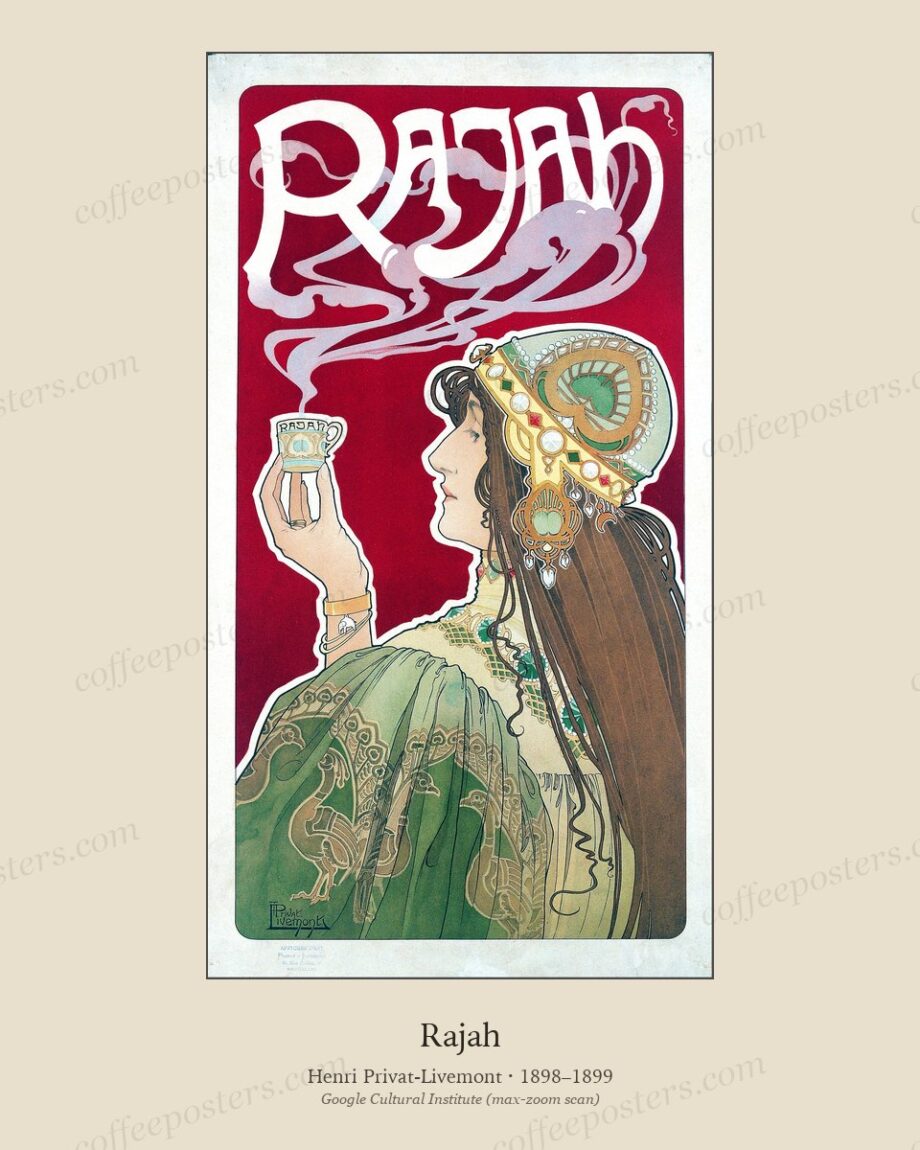
Henri Privat-Livemont’s Rajah (1898–1899) is the canonical Belle Époque
coffee poster: a large chromolithograph printed at the J.-L. Goffin workshop in Brussels for a small
Belgian colonial-import house that sold both coffee and tea. It is the companion piece to Henri
Meunier’s 1897 Thé Rajah — same brand, same workshop, two years apart.
By Coffee Posters · Published June 2026
What it is
A coffee advertising poster, designed by Henri Privat-Livemont, commissioned in 1898 and printed
in 1899. It shows a turbaned figure seated against the dense ornamental border typical of
Privat-Livemont’s mature work, holding a stylised cup. Original prints ran roughly
100 × 50 cm at full scale. It is the single most reproduced example of Belle
Époque coffee advertising from Belgium, and the piece most people picture when they picture an
“Art Nouveau coffee poster.”
Who made it
Henri Privat-Livemont (Belgian, 1861–1936). By 1898 he was the most-commissioned poster
designer in Brussels, at the peak of a commercial run that had already produced Absinthe
Robette (1896) and Cacao Van Houten (1897). He trained at the Académie royale
des Beaux-Arts in Brussels and in Paris, then spent twenty-five years designing posters, programs,
and applied-arts ornament. The Rajah commission came when his fee was high enough that smaller brands
struggled to afford him.
Where it was printed — and why it still hangs
At the J.-L. Goffin workshop on the rue Royale in Brussels, the largest chromolithographic printer
in Belgium at the time. Two reasons the print survives so well. First, the technique:
chromolithography in this period had reached a quality plateau later commercial printing never beat
cheaply — hand-registered multi-colour separations produced edges and tonal transitions modern
offset can only match at much higher cost. Second, the stock: the heavyweight matte coated paper the
Brussels and Paris workshops used ages well, so surviving prints read much as they did the day they
came off the press.
| Field | Detail |
|---|---|
| Designer | Henri Privat-Livemont (1861–1936) |
| Date | Commissioned 1898, printed 1899 |
| Workshop | J.-L. Goffin, Brussels |
| Technique | Chromolithography, multi-colour separation |
| Original size | ~100 × 50 cm |
The companion piece
The same brand had commissioned a tea poster two years earlier: Henri Meunier’s
Thé Rajah (1897), printed at the same Goffin workshop. The two are companion pieces
in the collector literature — same Brussels colonial-import house, same press, same orientalist
commercial register that ran through European coffee, tea, and tobacco advertising between roughly
1890 and 1914. The brand never grew large; what outlived it were the posters.
This piece in the archive:
CA-001 Rajah — see also its companion
CA-009 Thé Rajah by Henri Meunier.
Frequently asked questions
What year is the Rajah poster?
Commissioned in 1898 and printed in 1899. It belongs to the peak of Privat-Livemont’s
commercial-poster career.
Is Rajah the same as Thé Rajah?
No. They share the brand and the Goffin workshop, but Rajah (1898–1899) is
Privat-Livemont’s coffee poster, while Thé Rajah (1897) is Henri
Meunier’s tea poster. They are companion pieces, not the same image.
Who was the brand?
A small Belgian colonial-import house that sold both coffee and tea between roughly 1895 and 1914,
based in Brussels. It left little behind beyond its posters and a short trade-card series.
Further reading
- Henri Privat-Livemont and the Brussels print culture, 1895–1910
- The orientalist question in Belle Époque coffee advertising
- How chromolithography made the coffee poster possible
Coffee Posters curates, restores, and reformats public-domain coffee visuals for archival-quality
printing. Browse the archive ·
About.