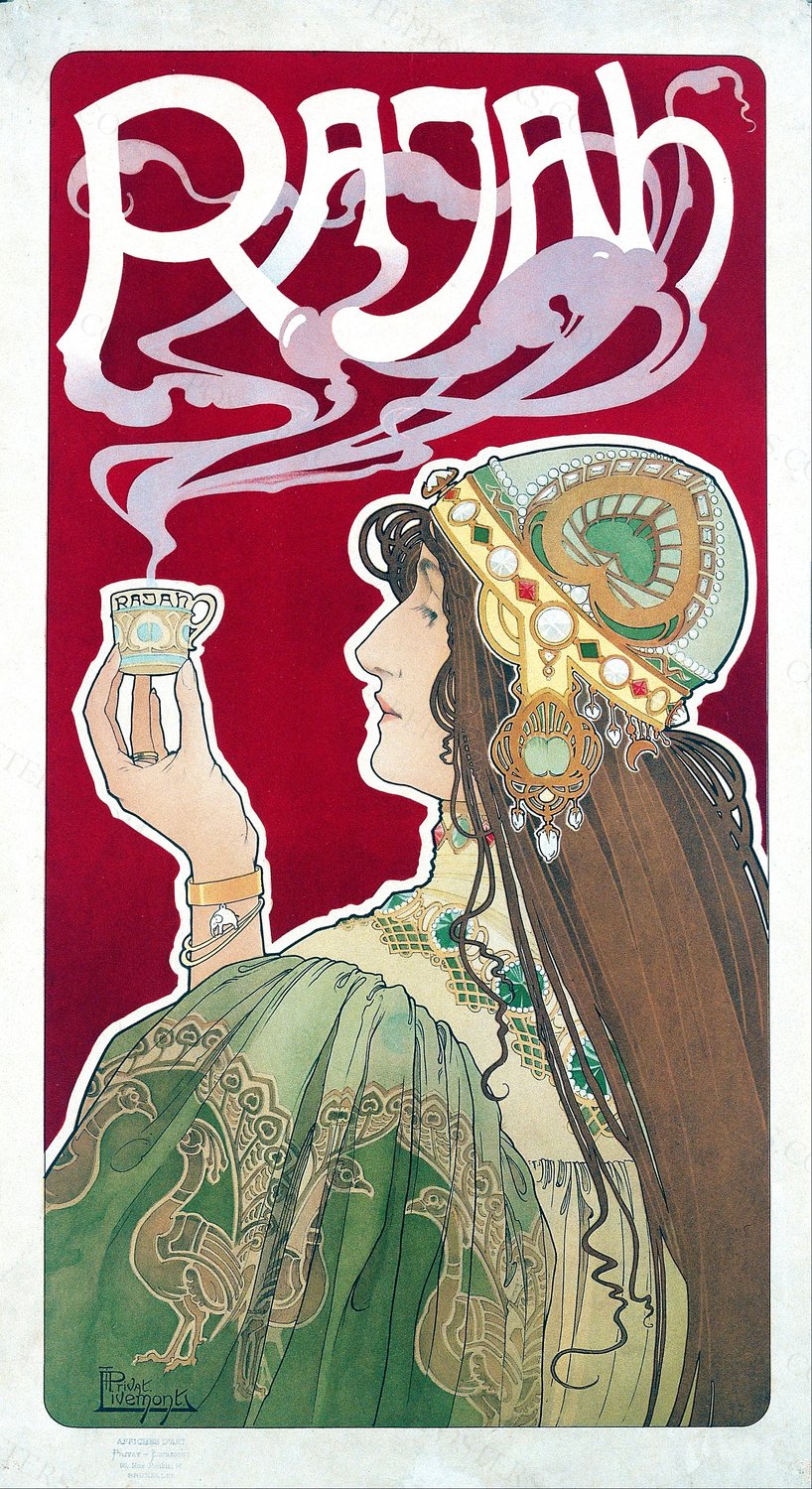
Privat-Livemont’s Rajah is the canonical Belle Époque coffee poster. But Privat-Livemont himself was one of about a dozen designers who worked the same Brussels print circle between 1895 and 1910, producing nearly every coffee, tea, and chocolate poster that survives from the era. This is a short tour of who they were, where they worked, and why their stuff still hangs on cafe walls a hundred and twenty-five years later.
The designer
Henri Privat-Livemont was born in Schaerbeek, a Brussels suburb, in 1861. He trained at the Académie royale des Beaux-Arts in Brussels, then in Paris under Auguste Lemmonier between 1883 and 1889. He came back to Brussels and spent the next twenty-five years designing posters, programs, and applied-arts ornament for Belgian and French clients. He died in 1936.
His commercial run peaked between roughly 1895 and 1905. The Absinthe Robette poster (1896) and Cacao Van Houten (1897) made his reputation; the Rajah commission for the Brussels colonial-import house came in 1898 and was printed in 1899. By the time he turned forty he was the most-commissioned poster designer in Brussels, charging fees that small brands struggled to meet.
The workshop: Goffin in Brussels
Almost every poster Privat-Livemont produced after 1895 was printed at the J.-L. Goffin workshop on the rue Royale in Brussels. Goffin was the largest chromolithographic printer in Belgium at the time, with a press capacity that handled four-, five-, and six-color separation runs at scale. The workshop also printed Henri Meunier’s posters (including the 1897 tea-side Thé Rajah), most of Privat-Livemont’s commercial work, and contracts from continental brands across the German-Belgian-French border.
The Goffin name appears in the lower margin of nearly every period Brussels poster. It is the single most useful provenance mark on a piece from this period — if you see Imp. J.-L. Goffin, Bruxelles in the corner, you are looking at the press that made the canonical Belle Époque coffee and tea poster output.
The Brussels designer circle
Privat-Livemont was the most famous, but he was not alone. Working out of the same Brussels print culture between 1895 and 1910:
- Henri Meunier (1873–1922) — Belgian, twelve years younger than Privat-Livemont. Designed the 1897 Thé Rajah companion poster for the same coffee/tea brand. His commercial output was smaller but the work is graphically sharper; his compositions tend to be tighter, more reduced.
- Henri Cassiers (1858–1944) — specialized in maritime and travel posters; designed for Red Star Line and several Belgian colonial-import houses.
- Fernand Toussaint (1873–1956) — portraitist-turned-poster-designer; designed beer and food advertising in the same period.
- Adolphe Crespin (1859–1944) — mostly architectural ornament but produced commercial posters in the late 1890s.
None of these designers worked in isolation. The Brussels print circle was small enough that they shared workshops, met at the same cafés, and competed for the same brand commissions. Privat-Livemont and Meunier almost certainly knew each other; the Rajah brand commissioning both of them within two years was probably a deliberate both/and, not a switch from one to the other.
Why the work still hangs
Two technical reasons and one cultural reason.
The technical reasons: chromolithography in this period had reached a quality plateau that hasn’t been beaten by any subsequent commercial-print technology. The hand-registered four- and six-color separations produced edges and tonal transitions that modern offset and digital printing can match only at much higher cost. And the paper stock used by Goffin and the major Brussels and Paris workshops — a heavyweight matte coated stock — ages well; the surviving prints look like the day they came off the press.
The cultural reason: the visual register of Brussels Belle Époque commercial print sits comfortably between fine art and graphic design without committing to either. The work is decorative enough to read as art object in a domestic setting, commercial enough to read as branding signage in a cafe or shop setting. That dual reading is what makes a Privat-Livemont poster work on a cafe wall in 2026 the way it worked on a Brussels storefront in 1899.
In the archive
- CA-001 — Henri Privat-Livemont, Rajah, 1898–1899
- All Belle Époque coffee art
- All Art Nouveau coffee posters
- All Belgian coffee art