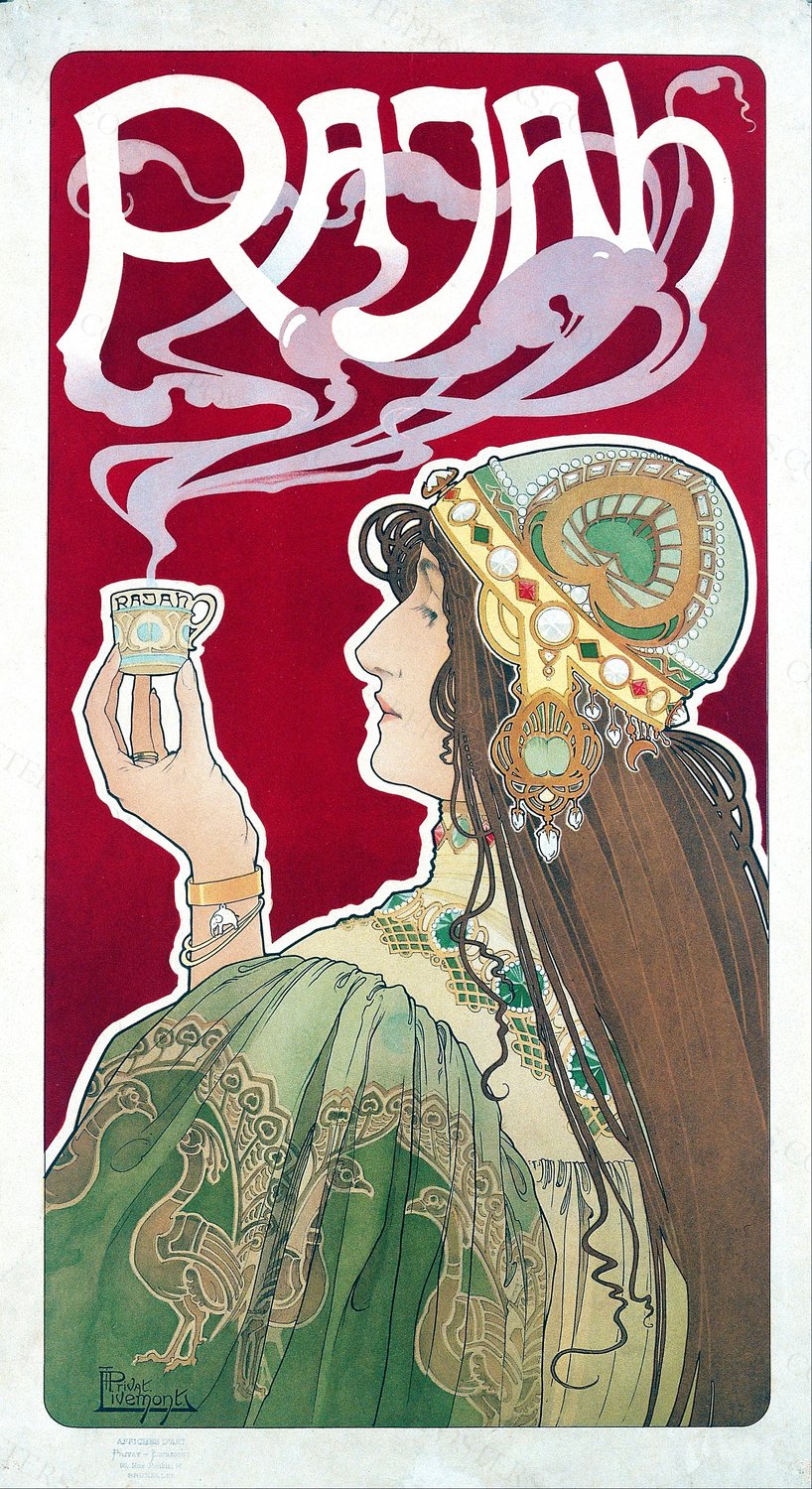
The canonical Belle Époque coffee poster is a European commercial image that uses an exoticist visual register — turbaned figures, jewel-toned palettes, half-invented Eastern flora — to sell beans that were grown in colonial territories under European control. The visual record is real and the framing is what it is. This is the editorial position on why we include the work and how we describe it.
The historical setting
Coffee in 1899 was not produced in Europe. It was grown in Brazil (the largest producer by far), in the Dutch East Indies, in French West Africa, in Ethiopia, in the Caribbean, in Central America. Most of the production happened under colonial labour systems: in Brazil, recently-abolished slavery transitioning to coerced contract labour; in the Dutch East Indies, the cultuurstelsel forced-cultivation regime; in French Algeria and West Africa, settler-colonial agriculture; in Ethiopia and Yemen, smallholder production under European trade pressure.
The European customer drinking a cup of Brussels-brand coffee in 1899 was at the end of a supply chain that ran through several layers of colonial labour and trade infrastructure. Most customers had no direct sense of this. The poster that sold the brand to them substituted an aestheticised visual fantasy of ‘the source’ — a turbaned figure, a tiled archway, half-invented decorative flora.
The orientalist visual register
This fantasy register — ‘orientalism’ in Edward Said’s 1978 formulation — was the dominant commercial-advertising vocabulary for coffee, tea, tobacco, and chocolate between roughly 1880 and 1914. The conventions are recognisable across the period:
- A central figure, often a woman, in stylised ‘Eastern’ dress (turban, jewel-toned drapery, stylised ornament) that does not correspond to any specific real region
- Decorative flora invented from a small repertoire of generically ‘exotic’ plants — lotus, half-imagined acanthus, made-up palm forms
- Architectural elements (arched doorways, columns, tiled patterns) drawn from a stock library of orientalist motifs assembled in Paris and Brussels print shops
- A palette emphasising gold, deep red, and jewel tones — the colours of European 19th-century salon paintings of the East, not of any specific Eastern visual tradition
Privat-Livemont’s Rajah (1898–1899) and Henri Meunier’s Thé Rajah (1897) are textbook examples. The figure is European-academic in proportion and rendering, dressed in a costume assembled from orientalist studio convention, against decorative motifs that don’t correspond to any actual Eastern decorative tradition. The brand was a Brussels colonial-import house selling beans the company sourced through European colonial trade infrastructure; the poster sold the beans by visualising an imagined ‘source’ that bore little relation to where the beans actually came from.
Why we include the work
Three reasons.
First: the visual record is real. The posters existed, the brand existed, the trade existed. To pretend the orientalist commercial register didn’t happen would be a different kind of dishonesty than the one the posters themselves committed.
Second: the work survived. By accident of paper and ink quality, the Belle Époque coffee poster is one of the densest visual archives we have of late-19th century European commercial culture. The same archive contains documentary evidence about the production techniques, the brand ecosystem, the print workshops, and the visual conventions of the era. Removing the orientalist examples removes a significant fraction of what we have.
Third: the question of how Europe visualised its colonial sources is a question worth keeping open. The posters are documents of that visualisation. The customer who puts a Rajah on a cafe wall in 2026 is, at some level, displaying a document of European commercial fantasy from 1899. Whether they think about that or not is up to them; the option to think about it should be available.
Why we don’t romanticise it
We don’t write copy that calls the posters ‘exotic charm’ or ‘a window into another world.’ We don’t pretend the visual register was a neutral documentary record. We don’t strip the historical framing from the product description in the interest of clean retail copy.
What we do write is what we wrote earlier in this article: ‘European commercial art borrowing an exoticist register to sell beans grown elsewhere.’ The framing is named. The buyer makes their own decision about whether that’s a wall they want to be near.
What this means for putting one on a wall
It means putting one on a wall is a small editorial act. If a cafe owner picks Privat-Livemont’s Rajah for the back wall, they are choosing a Belle Époque chromolithograph that participates in the orientalist commercial register. They might do this because they value the graphic design and consider the framing’s distance in time sufficient to neutralise it. They might do it because they want the framing to be visible and conversational. They might do it because they didn’t think about it. All three are choices a customer makes; the archive doesn’t tell them which to make. It just doesn’t paint over what the choice involves.
Adjacent reading
- Ottoman coffeehouses in European travel lithography, 1820–1880
- Brazilian fazenda paintings: Ferrigno, Norfini, and São Paulo’s coffee art
- Two Rajahs: Privat-Livemont and Meunier in Brussels, 1897–1899
Related reading and browsing
- Privat-Livemont and Brussels print culture — the Rajah context
- Ottoman coffeehouses in travel lithography — the coffeehouse-image context
- Brazilian fazenda paintings — the origin-image context