Nearly every visual record of an Ottoman coffeehouse before photography was made by a European travel artist who visited Constantinople, Cairo, Damascus, or Smyrna and brought sketches back to a Paris or London lithographic workshop. The resulting prints — a recognisable genre between 1820 and 1880 — are documentary and orientalist at the same time. This is the short tour of how to read them.
The institutional setting
The Ottoman coffeehouse — kahvehane — had been the institutional centre of public coffee drinking since the 1550s. By the early 19th century the European travelling artist arriving in Constantinople would find a dense network of coffeehouses serving every neighbourhood: large central rooms with low benches along the walls, small individual rooms behind curtains for private conversation, courtyards in summer, brass-fitted serving counters at the door. The institutional form had been stable for two and a half centuries and would remain stable for another century after.
What changed in the 1820s–1880s was the European interest in documenting it. The opening up of the Ottoman Empire to broader European travel, the romantic-orientalist taste in Paris and London salon culture, and the cheap availability of lithographic publishing all converged. A traveller could sketch a coffeehouse interior in Constantinople in 1842, return to Paris, sell the sketches to a publisher, and have the lithograph in shops by 1843.
The principal artists
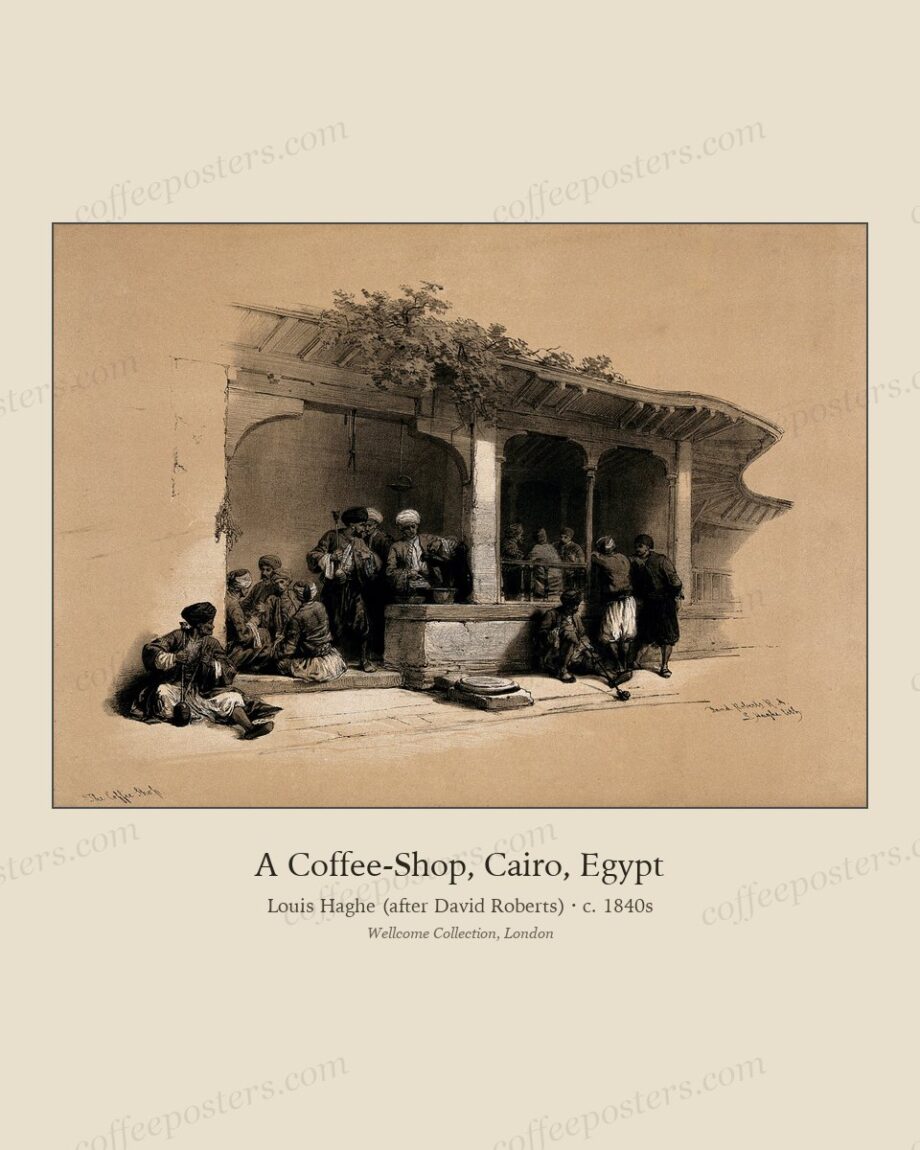
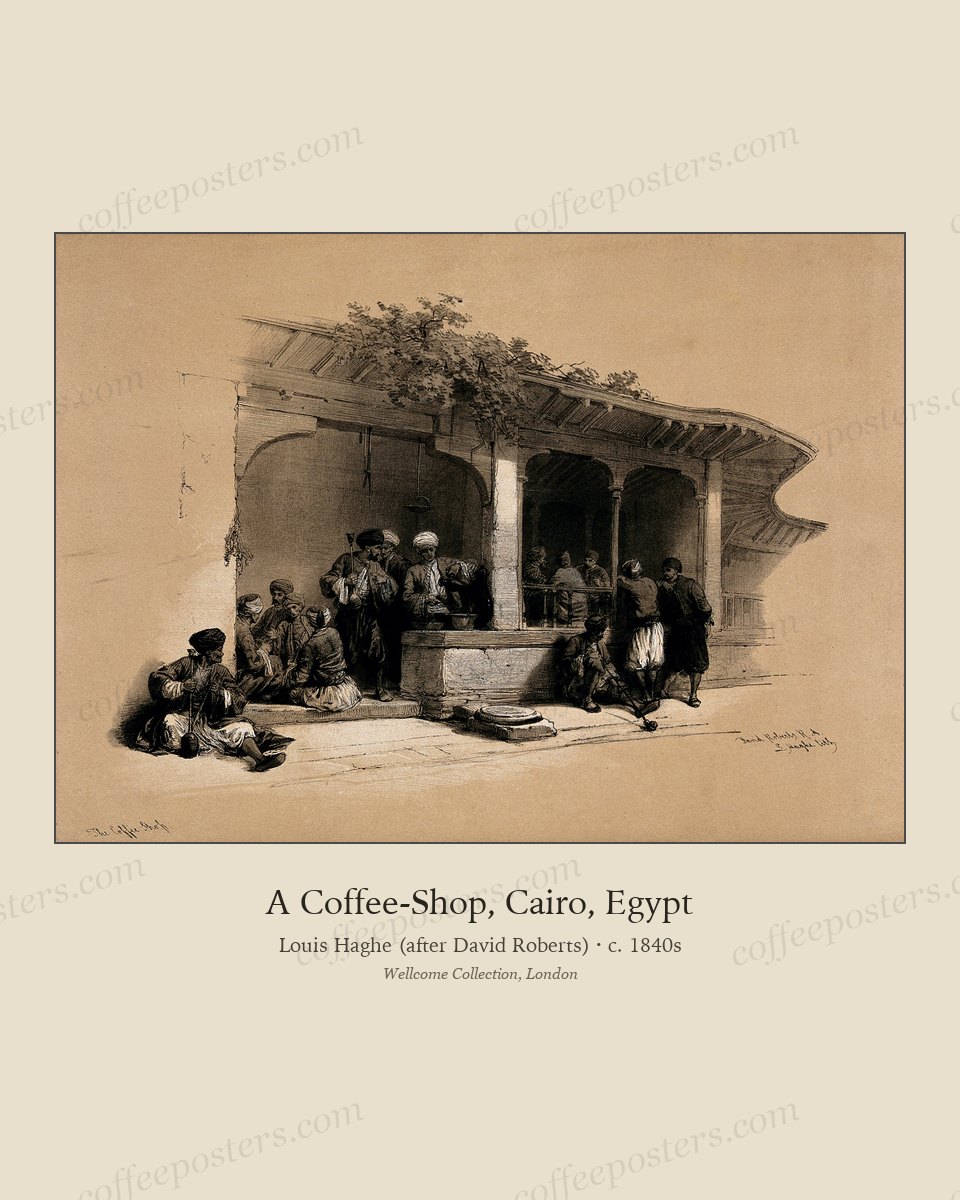
David Roberts (1796–1864), Scottish. His Egypt and Nubia (1846–49) and The Holy Land (1842–49) included a number of coffeehouse and café interiors from Cairo, Jerusalem, and Damascus. The plates were lithographed by Louis Haghe in London. The Cairo coffeehouse plate held by the Wellcome Collection (CA-002 in this archive) is from this set.
Eugène Flandin (1809–1889), French. Traveled with the French diplomatic mission to Persia in 1840–41, then independently through the Ottoman Empire. His plates of Constantinople and Smyrna coffeehouses are among the most architecturally accurate of the period.
William Henry Bartlett (1809–1854), English. The Beauties of the Bosphorus (1838) and the Holy Land plates include coffeehouse scenes; he was less interested in the human figure than in the architectural setting.
Amadeo Preziosi (1816–1882), Maltese resident of Constantinople. The exception to the rule: lived in the city for thirty years, knew the coffeehouses as a regular customer not as a visitor. His watercolours of Constantinople coffeehouses are the most reliable interior documents of the era.
What the prints get right
The architectural detail is generally accurate. Wood-fitted ceilings, brass coffee equipment, water-pipes (nargileh), low benches with cushions, prayer-bead strings hanging from rafters, the layout of the serving counter — these match surviving photographs from the 1860s–70s and surviving architectural elements in coffeehouses that operated continuously into the 20th century.
The brewing equipment is also accurate. The long-handled brass coffee pot (ibrik), the small unglazed cups, the small tray with sugar lumps and water glass alongside — these match Ottoman museum holdings and have changed remarkably little over four centuries.
What the prints get wrong, or stylise
The human figures are usually the weakest part. Most travel artists worked from cursory sketches of one or two real Ottoman coffeehouse patrons, then populated their published scenes with composite figures drawn from a small repertoire of orientalist studio types. The clothing is plausible but often non-specifically dated. The poses are arranged for European visual narrative interest rather than for accurate observation of Ottoman social behaviour.
The lighting is also usually compressed for visual effect. A real 19th-century Ottoman coffeehouse interior would have been dim, lit by small oil lamps and the small windows above the front door. The published prints show light levels that read clearly for the European salon viewer.
How to read them now
Two readings, both valid. As documentary record: the architectural and equipment detail is reliable, often the only surviving visual record of specific spaces that no longer exist. As orientalist commerce: the prints were made for a European market that bought the exotic register; the framing carries that. Both readings are correct at the same time and the print sits in this archive on both grounds. We don’t romanticise the orientalist framing and we don’t dismiss the documentary value either.
In the archive
- CA-002 — Louis Haghe after David Roberts, A Coffee-Shop, Cairo, c. 1840s
- All Romantic / Orientalist coffee art
- All Ottoman & Levantine coffee imagery
Related reading and browsing
- Ottoman / Levant pieces — the regional tag for coffeehouse scenes and related works
- Romantic & Orientalist pieces — the period tag for European travel lithography