Historical context
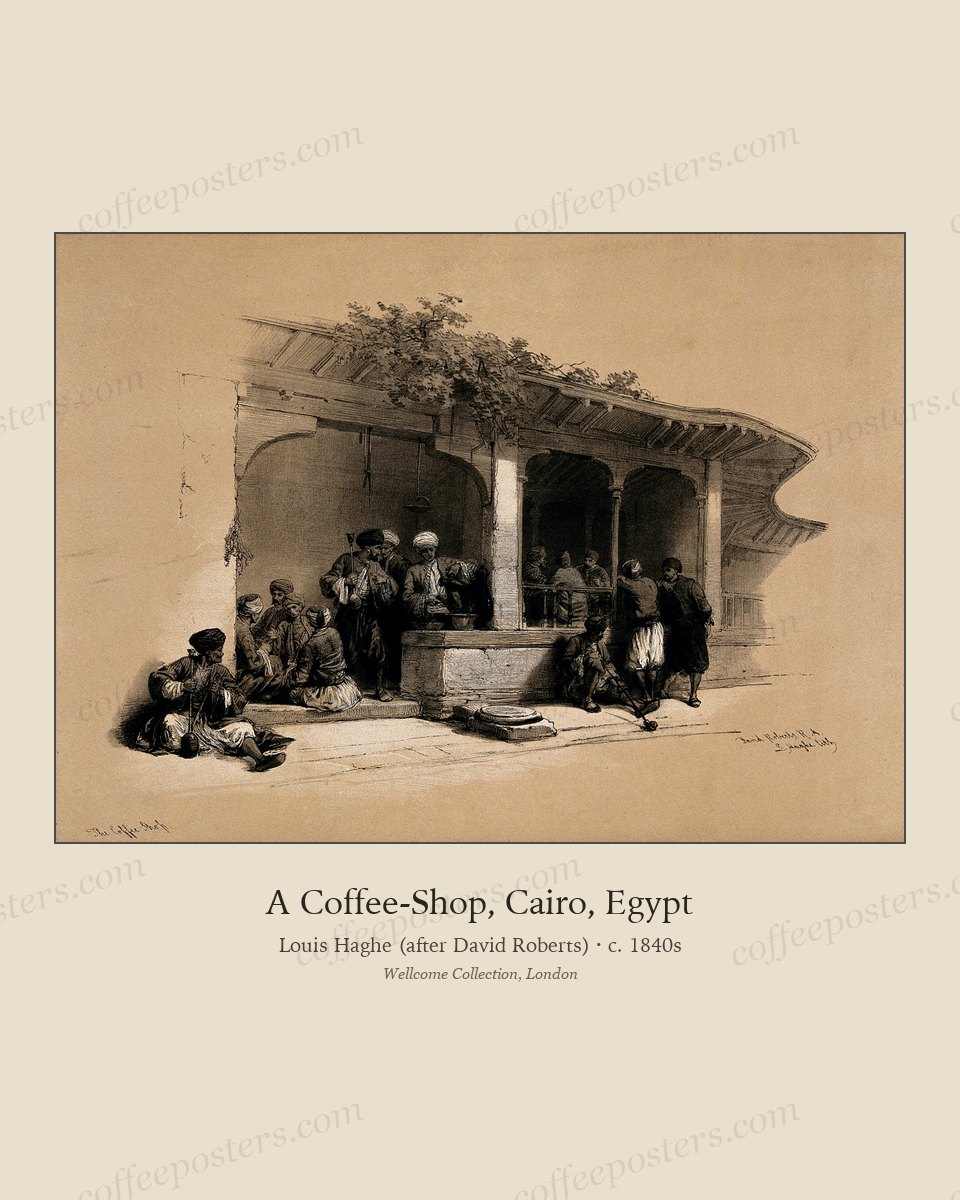
A Coffee-Shop, Cairo is a hand-colored lithograph drawn by the master lithographer Louis Haghe after a watercolor by the Scottish painter David Roberts. It belongs to Roberts’ six-volume series The Holy Land, Syria, Idumea, Arabia, Egypt & Nubia, published in London between 1842 and 1849 by F.G. Moon. The plates were drawn on stone by Haghe, printed at the Day & Son workshop in London, and finished by hand in watercolor.
Roberts traveled through Egypt and the Levant in 1838–1839 with introduction letters that gave him access to mosques and private interiors normally closed to Europeans. The Cairo coffeehouse plates — there are several across the series — record the public coffee-drinking culture that had been continuous in the city for roughly three centuries by then.
Day & Son’s process for these volumes was unusual for the period: Haghe drew each tonal layer onto a separate limestone plate by hand — lithography in this case being a translation craft as much as a printing one — and the finished print was then colored in watercolor by a team of London colorists working from Roberts’ watercolor reference.
Surviving copies vary in color saturation depending on how the colorist worked and how the sheet has been kept. The Wellcome Collection holding used as our digital source is at the stronger end of the spectrum; ochres and reds read closer to the original Roberts watercolor than the more typical faded copies on the market.
The file is a 3129 × 2245 px 300-DPI scan from Wellcome Collection’s open-access program, released under CC BY 4.0. At native scale it prints cleanly at 10 × 7 inches; with careful upscaling it carries to 14 × 10 inches before the litho stipple begins to show. We recommend native size in a generous mat.
Catalog
| Artist | Louis Haghe (after David Roberts) Belgian/British, 1806–1885 / 1796–1864 |
|---|---|
| Title | A Coffee-Shop, Cairo, Egypt |
| Year | c. 1840s |
| Medium | Hand-colored lithograph |
| Original size | ≈ 35 × 25 cm (plate) |
| Holding | Wellcome Collection, London |
| License | CC BY 4.0 · attribution: Wellcome Collection |
| Archive № | CA-002 |
Print specifications
The size the lithograph was designed to be read at. Matte fine-art paper holds the hand-coloring best; gloss flattens the ochre palette.
Works well as a paired hang next to other Wellcome Levantine plates from the same series. Frame in a warm dark wood, mid-weight mat.
Pushable but the lithographic dot pattern will be visible at close inspection. Acceptable across a room; we wouldn’t choose it as a desk-distance hang.
Source statement
Digital source: Wellcome Collection, London, accession via wellcomecollection.org. Wellcome released the file under CC BY 4.0; the credit line on the bottom of the print and on the licensing page below reflects that attribution requirement.
Original work: Louis Haghe after David Roberts, A Coffee-Shop, Cairo, Egypt, hand-colored lithograph, c. 1840s. Plate from The Holy Land, Syria, Idumea, Arabia, Egypt & Nubia (London: F.G. Moon, 1842–1849).
Restoration notes. Minor scan-edge cleanup; spot removal on the upper margin where the original sheet shows foxing. Color values preserved from source.
![Théâtre du Chat noir. [Couverture aux coquelicots] : [couverture de programme] / George Auriol](https://coffeeposters.com/wp-content/uploads/2026/06/CA-030-420x525.jpg)