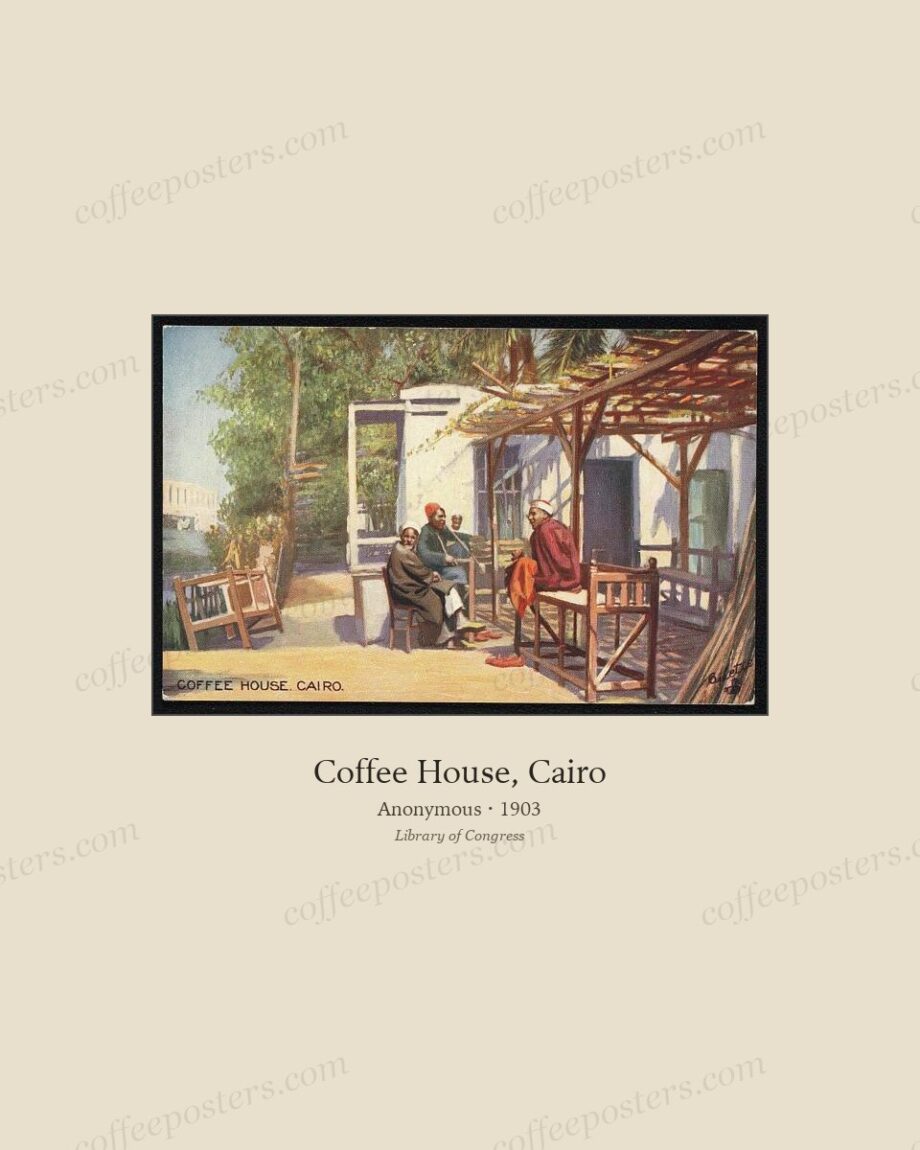
TL;DR — The itinerant coffee vendor was a stock figure of 19th-century European travel prints of the Ottoman world: a man with a brazier, a long-handled cezve, and a tray of small cups, recorded as an emblem of the East. The prints are vivid documents of a real practice and, at the same time, carriers of the period’s orientalism — the coffeehouse of the imagination sold to a Western audience.
By Coffee Posters · Published September 2026
A recurring figure
Europeans encountered coffee as an Ottoman institution — the word itself travelled from Arabic qahwa through Turkish kahve — and the street coffee vendor became one of the defining images that travelling and armchair-travelling artists brought home. The brazier of coals, the long-handled pot, the tray of small handleless cups, the seller threading through a market or resting by a wall: the figure recurs across French, British, and German travel imagery from roughly 1820 to 1880.
It sat at the intersection of two things European audiences were fascinated by — coffee, still glamorous and relatively new, and the “Orient” — which is why it was drawn, engraved, and lithographed so often and survives so widely.
Document and stereotype
These prints record genuine practice: itinerant coffee-selling was real, the equipment is accurately observed, the social role authentic. But they were made for a European market and framed by its assumptions — the timeless, picturesque, unchanging East that Edward Said later named orientalism. The vendor is often less an individual than a type, a costume study, an emblem of an imagined region. The image is useful evidence and, simultaneously, an example of how the East was packaged for Western eyes.
Coffee’s origin story, illustrated
The vendor prints also carried, to European viewers, coffee’s own origin myth — the drink came from the East, from Yemen and the Ottoman lands, and these images were the visual proof of that pedigree. Long after Europe grew its own coffee culture and the Americas dominated production, the advertising and imagination of coffee kept returning to the turbaned figure and the small cup, because that was where coffee’s romance lived. The Belle Époque “Rajah” posters draw directly on this inheritance.
Reading them now
For a modern viewer these prints reward a double reading: enjoy them as vivid, skilful records of a real and now-vanished street trade, and recognise them as products of a specific European fantasy of the East. Both are true at once. That double vision is the honest way to hang an orientalist coffee print — as document and as evidence of how images do their work.
In the archive: view the featured piece.
Frequently asked questions
Who was the Ottoman coffee vendor in prints?
An itinerant street seller with a brazier, long-handled pot, and tray of small cups — a stock figure of 19th-century European travel prints of the East, drawn from roughly 1820 to 1880.
Are these prints reliable records?
Partly. They accurately observe a real trade but were made for European audiences and carry the period’s orientalist framing, often turning the vendor into a picturesque type.
Why did European coffee imagery keep returning to the East?
Coffee’s origin myth located it in Yemen and the Ottoman lands, so its romance — and its advertising, up to the Belle Époque Rajah posters — kept invoking the turbaned figure and the small cup.
Further reading
- Ottoman coffeehouses in travel lithography
- The orientalist question in Belle Époque advertising
- Where these images come from
Coffee Posters curates, restores, and reformats public-domain coffee visuals for archival-quality printing. Browse the archive · About.