The archive draws from eight institutional sources. Each is strong at something different. This is the short tour of who they are, what they hold, and how we choose what to bring into the archive.
Why eight sources, not one
Any one institutional collection has its visual bias. A library that built its holdings around 19th-century medical illustration will be strong on botanical and pharmacological plates and thin on Belle Époque commercial print. A national library that grew through legal-deposit will be strong on its country’s commercial print and thin on foreign material. A digital-archive aggregator will be wide but shallow.
An archive built around a single institutional source inherits that institution’s bias. An archive built around eight institutional sources, cross-checked against each other, ends up with a more balanced view of the period than any single source provides.
The eight sources
Wellcome Collection (London)
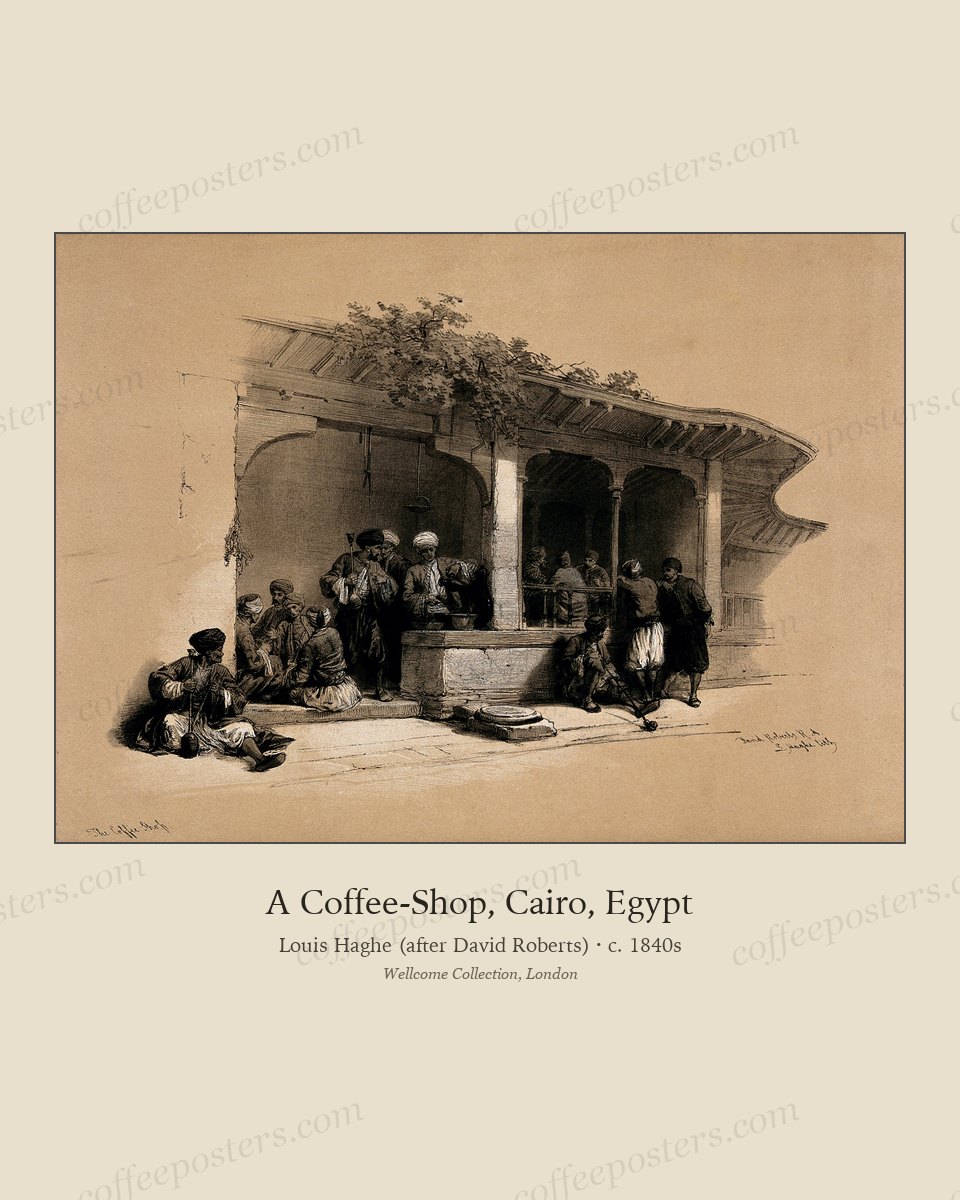
The Wellcome Trust was founded in 1936 from the personal collection of pharmaceutical-trade founder Henry Wellcome. The collection’s original focus was the history of medicine and human health; coffee enters through that door — as a 19th-century medicinal stimulant, as a public-health subject in the Ottoman-empire holdings, and as a botanical-pharmacological reference.
Strongest at: 19th-century Ottoman coffeehouse lithographs, medical-botanical plates of Coffea arabica, pharmaceutical-trade ephemera. The Wellcome has released most of its holdings under CC BY 4.0, which is unusually generous for a major UK collection.
Bibliothèque nationale de France (Gallica)
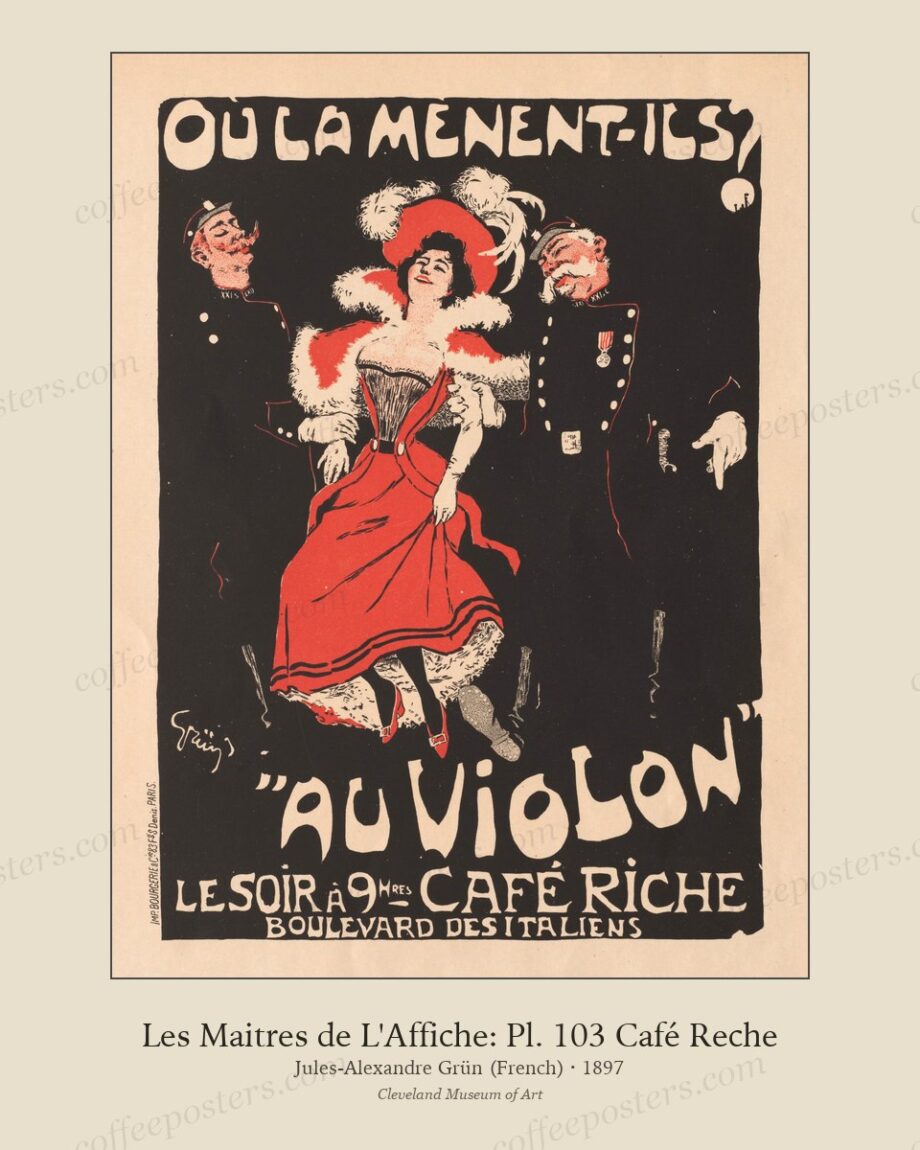
The French national library’s digital arm. Gallica is the largest online repository of pre-1929 French printed material in the world. For coffee it is the deepest source for Belle Époque French commercial print — posters, cabaret programs, magazine illustration, French colonial-coffee advertising. The Chat Noir program covers (George Auriol’s design work) are Gallica holdings.
Strongest at: French commercial print 1880–1920, French colonial-coffee material, Chat Noir / Mirliton / Folies-Bergère cabaret programs.
Library of Congress (Washington)
The United States’ national library’s prints & photographs division. The coffee material is mostly American: 19th-century coffeehouse engravings, late-19th and early-20th-century coffee-brand chromolithograph trade cards, stereographs of coffeehouses and plantations, and a small but well-catalogued holding of European posters acquired through gift and exchange. Strongest at: American material; thinner on European Belle Époque.
Rijksmuseum (Amsterdam)
The Dutch national museum. Coffee enters through three doors: 17th- and 18th-century Dutch coffee-trade material (the Dutch East India Company financed much of the early Indonesian coffee trade), Dutch domestic-genre paintings of household coffee drinking through the 19th century, and the modern open-data programme that has released a large fraction of the museum’s holdings under CC0.
Strongest at: Dutch domestic-genre, Dutch trade material, Indonesian-colonial coffee imagery.
Internet Archive
Not an institution in the museum sense but a non-profit digital library that holds, among other things, the Boston Public Library’s Tichnor Brothers postcard collection. The Tichnor cards are American chromolithograph trade-card material from the 1900s–1940s. The visual register is small-format and graphically dense — the trade-card aesthetic, not the poster aesthetic.
Strongest at: American chromolithograph trade cards (via the Boston Public Library Tichnor collection), early-20th-century coffee advertising.
Museu Paulista da Universidade de São Paulo
The São Paulo state museum. Holds the canonical Brazilian fazenda paintings — Ferrigno, Norfini, Calixto. The museum’s open-access programme has released digital reproductions of the major fazenda canvases. Strongest at: Brazilian plantation painting, São Paulo agricultural visual history.
Google Cultural Institute
The aggregator. Hosts maximum-zoom scans of works held by partner institutions worldwide. The Privat-Livemont Rajah and Henri Meunier Thé Rajah are accessible through the Cultural Institute as gigapixel-quality scans contributed by the holding Belgian collection.
Wikimedia Commons
The widest source. Wikimedia Commons aggregates public-domain visual material from many of the above institutions plus several hundred others, all under unified licensing. It is the right starting point for any cross-source search, even when the original holding institution is preferred for provenance.
How we choose what to bring in
For each candidate piece across the eight sources, we apply four filters:
- Visual quality. The piece has to read well at standing-figure scale. Brightness is in the middle range (not a near-white text page, not a near-black under-exposed scan). Contrast is high enough that detail survives at print size. Colour is rich enough that the piece doesn’t read as flat. A black-and-white piece is allowed only if its line work is unusually fine.
- Resolution adequate for at least 8×10 inch print at 300 DPI. Source resolution roughly 2400 pixels on the long edge minimum; ideally 3300 pixels for 11×14 or 4800 for 16×20.
- Public-domain status. Original work in the US public domain; sometimes CC0 or CC BY 4.0 from the institution. We do not include rights-restricted material.
- Subject coherence. The piece’s primary subject is coffee — the plant, the harvest, the cafe, the equipment, the cup, the brand. Pieces where coffee is incidental are not included.
What this means for the buyer
You are buying a piece whose institutional holding is known and whose restoration history is documented. That is the difference between an archival piece and a generic vintage print: the chain of custody can be traced back to the institution that catalogued the work, and the work the institution did to preserve and digitise it is the work that makes your print possible.