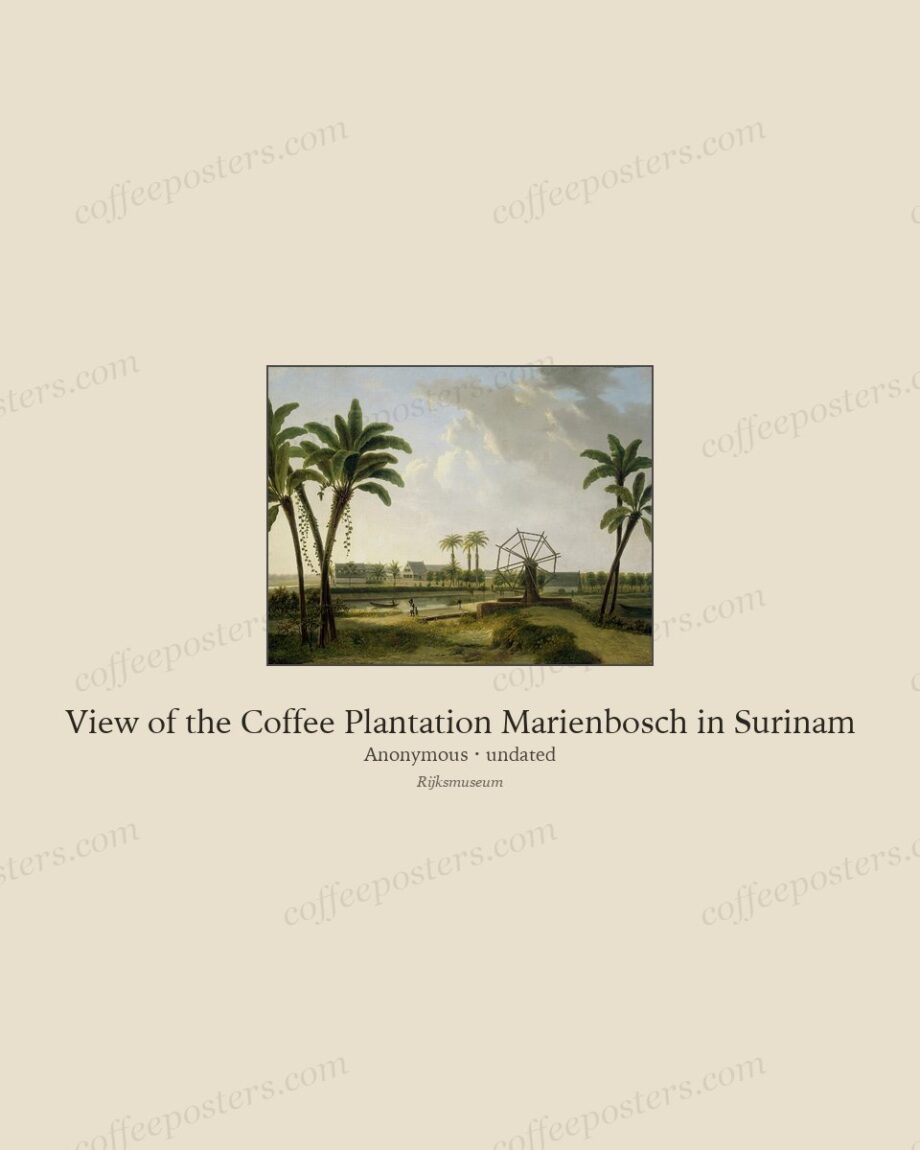
TL;DR — Colonial Dutch art recorded the Indonesian coffee plantation in detail — the terraced hillsides of Java and Sumatra, the drying yards, the labour — producing images that are at once handsome landscape and documents of a coercive cultivation system. “Java” became the world’s word for coffee, and this imagery is the origin end of that story.
By Coffee Posters · Published October 2026
Java, Sumatra, and the system
Under Dutch rule the East Indies became one of the world’s great coffee sources. From 1830 the Dutch imposed the Cultuurstelsel (Cultivation System), which forced Javanese peasants to devote land and labour to export crops including coffee, delivered to the colonial government at fixed low prices. It made the Netherlands rich and Java’s countryside coffee country — and it is the system Multatuli’s famous 1860 novel Max Havelaar attacked.
Colonial artists, surveyors, and illustrators documented the plantations that resulted: the laid-out terraces climbing the volcanic hillsides, the processing yards, the workers, the estate buildings, all recorded in the topographical tradition the Dutch excelled at.
Landscape and labour
These images are genuinely beautiful — the light on terraced green hillsides, the order of a well-run estate — and that is exactly the tension in them. They aestheticise a system of coerced labour, presenting extraction as scenery. Read for what they show, they document real places, techniques, and people; read for what they assume, they embody the colonial gaze that saw the plantation as a productive, orderly, and picturesque possession. Both readings are necessary.
A source-side image
Where the European poster shows the cup and the Parisian café, this material shows the field: the origin end of the supply chain, painted by the colonial power that ran it. It is the visual counterpart to the Brazilian fazenda painting on the other side of the world — two great 19th-century coffee frontiers, each recorded by the society that profited from it. For a bean-to-cup wall, the Indonesian plantation image supplies a link the European tradition simply doesn’t have.
Why it belongs in the archive
Colonial Indonesian coffee art completes the geography of the coffee image. Coffee is a global commodity, and its pictures come from everywhere the plant grew and everywhere it was drunk. To show only the Parisian poster is to show only the pleasure and hide the production; the Java plantation image, seen honestly, restores the other half of the story.
In the archive: view the featured piece.
Frequently asked questions
What do colonial Indonesian coffee images show?
The plantations of Java and Sumatra — terraced hillsides, drying yards, estate buildings, and labour — recorded in the Dutch topographical tradition.
Are these just landscapes?
No — they are landscapes and records of a coercive cultivation system (the Dutch Cultuurstelsel from 1830). They aestheticise extraction as scenery; both readings matter.
Why is “Java” linked to coffee?
The Dutch made Java a major coffee source from around 1700, and under the 19th-century Cultivation System it became coffee country — so much so that “Java” became a synonym for coffee.
Further reading
Coffee Posters curates, restores, and reformats public-domain coffee visuals for archival-quality printing. Browse the archive · About.