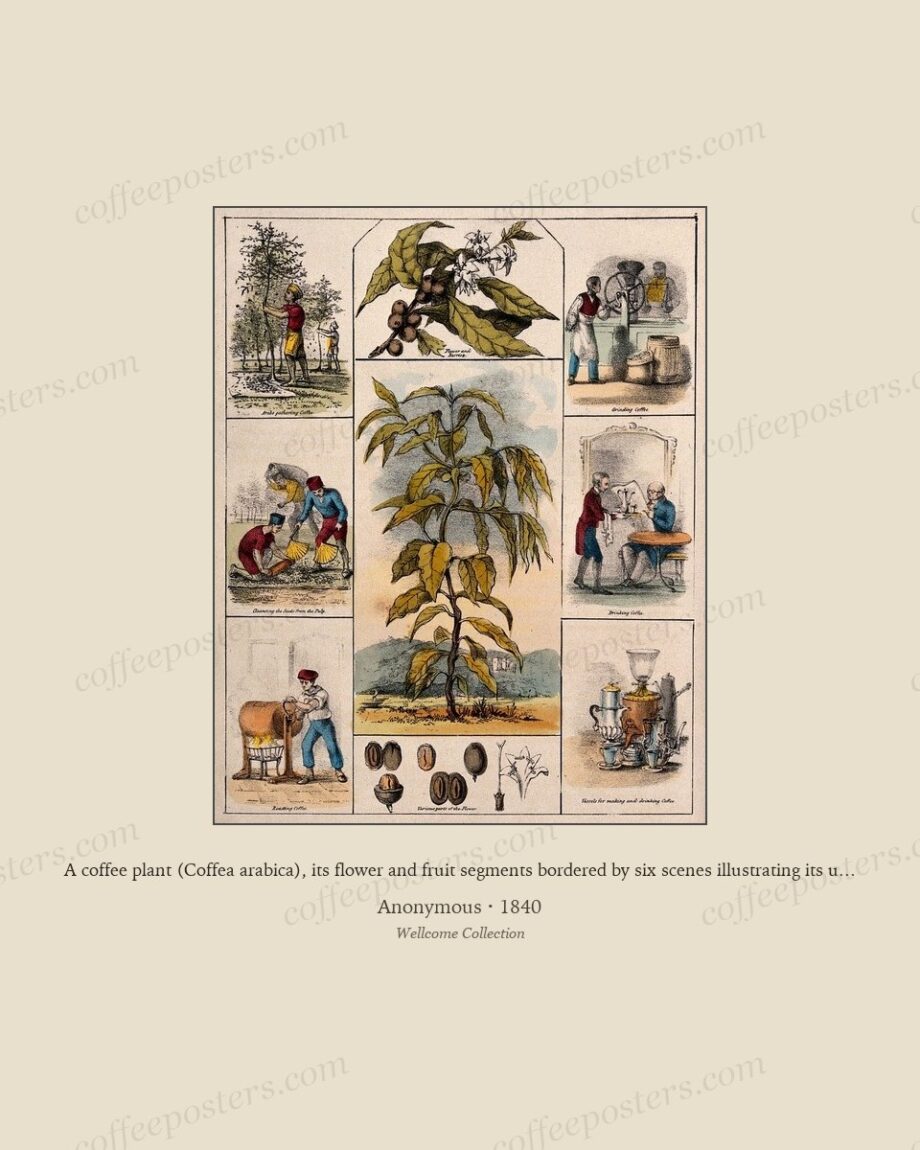
TL;DR — Dutch art recorded coffee as commerce earlier and more directly than most. From the Dutch East India Company (VOC) era through the 19th century, Dutch painting and print documented the plant, the colonial plantation in Java and Surinam, and the merchant’s world that made the Netherlands an early coffee power — images that are landscape and still life on the surface and economic history underneath.
By Coffee Posters · Published September 2026
The VOC and the bean
The Dutch were pivotal in turning coffee from an Arabian monopoly into a global colonial commodity. The VOC — the Dutch East India Company, founded 1602 — carried coffee cultivation to Java in the 1690s and 1700s, breaking Yemen’s control of the trade, and “Java” became a synonym for coffee itself. Dutch visual culture followed the money: botanical studies of the plant, views of the plantations, and the prosperous still-life world of the merchant class.
This gives Dutch coffee imagery a distinctive character. Where the French made coffee a matter of the café and the poster, the Dutch made it a matter of trade, cultivation, and colonial administration — the source end of the supply chain, seen from the perspective of the power that ran it.
Plantation and plant
Colonial-era Dutch images of coffee tend toward the documentary and the topographical: the plantation laid out in orderly rows, the drying yards, the processing, the plant studied in botanical detail. Views of estates in Java and in Surinam (the Dutch colony in South America) record the cultivation system with the same precision the Dutch brought to mapping and land survey. They are records of an economy as much as artworks, and they carry, for a modern viewer, the weight of the coerced colonial labour that made the system work.
The merchant’s still life
At the consuming end, coffee entered the Dutch still-life and genre tradition — the pot and cup on a merchant’s table, part of the inventory of comfort and global reach that Dutch painting had celebrated since the Golden Age. The same culture that painted Chinese porcelain, Turkish carpets, and exotic fruit as signs of a trading nation’s success absorbed the coffee service naturally into that visual accounting of prosperity.
A trade self-portrait
Taken together, Dutch coffee imagery is a self-portrait of a trading nation: the bean as wealth, the colony as source, the merchant’s table as reward, all rendered with the characteristic Dutch precision. For anyone assembling the origin end of the coffee story — a roastery wall, a supply-chain sequence — the Dutch plantation and trade images supply exactly the link between the botanical plate and the European cup that the poster tradition leaves out.
In the archive: view the featured piece.
Frequently asked questions
Why is coffee common in Dutch art?
The Dutch East India Company (VOC) carried coffee cultivation to Java and made the Netherlands an early coffee power; Dutch visual culture documented the plant, the plantation, and the trade.
What do Dutch coffee images show?
Often the documentary side — botanical studies, topographical plantation views in Java and Surinam, and the merchant’s still-life world — recording an economy as much as a subject.
Why did “Java” come to mean coffee?
Because the Dutch established large-scale coffee cultivation on Java from the early 1700s, breaking the Arabian monopoly and making the island a byword for the drink.
Further reading
- Brazilian fazenda paintings
- Indonesian coffee plantations in colonial Dutch art
- Coffea arabica in botanical illustration
Coffee Posters curates, restores, and reformats public-domain coffee visuals for archival-quality printing. Browse the archive · About.