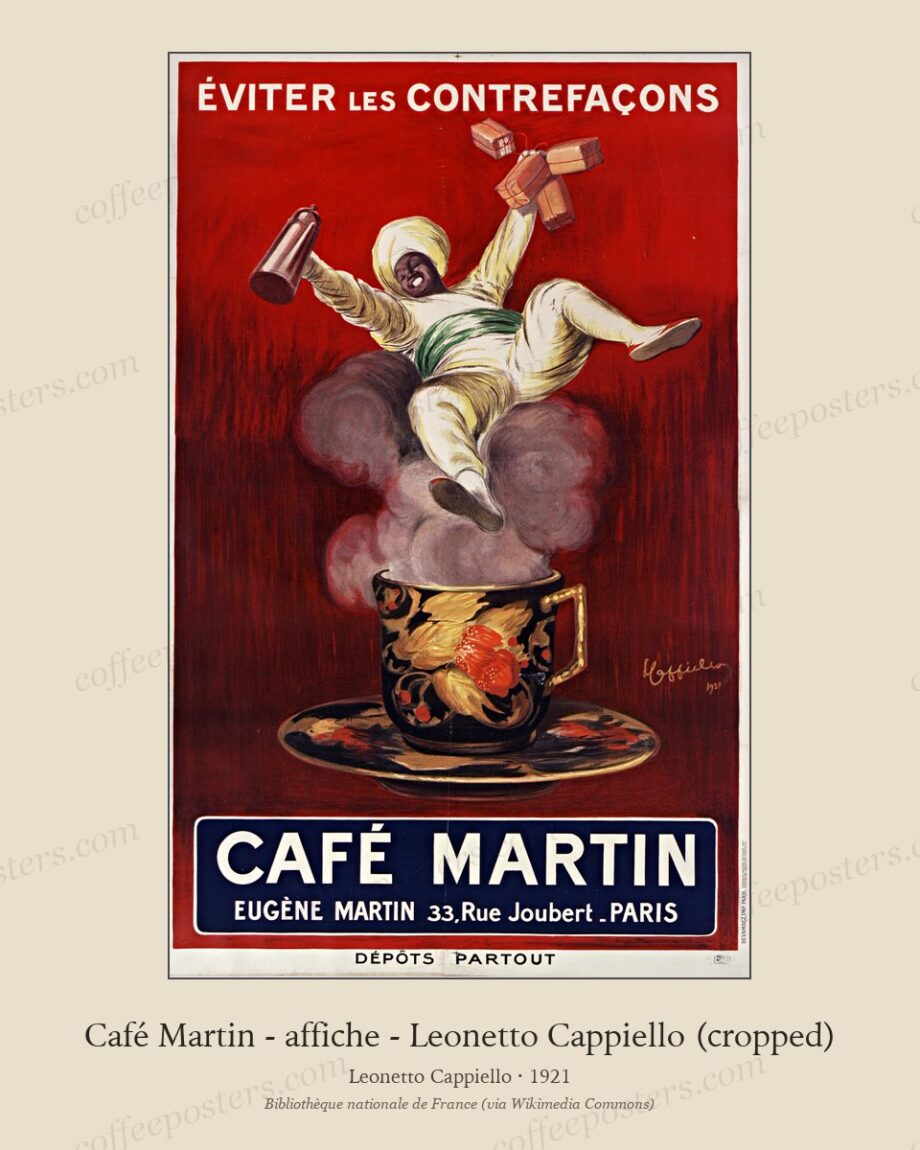
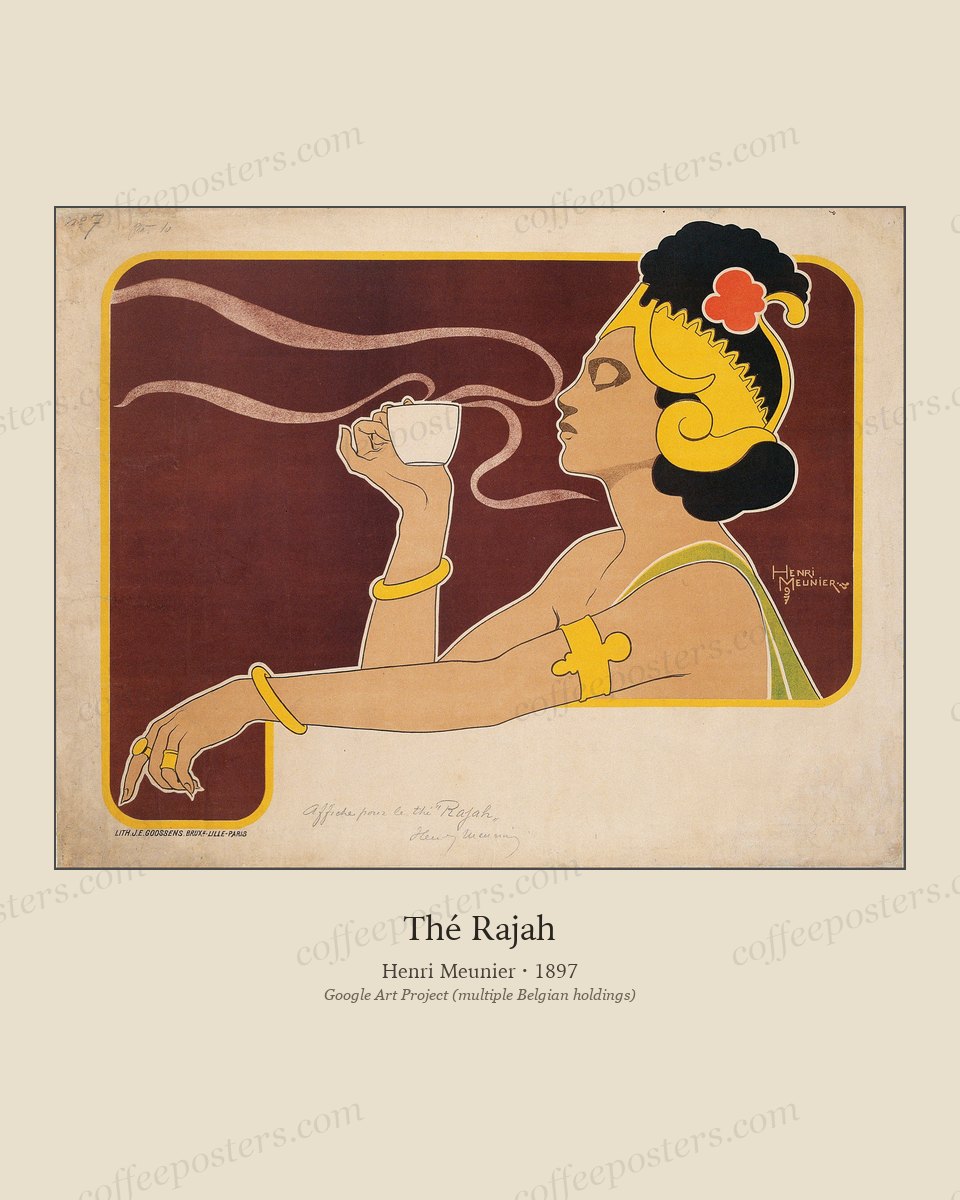
The Belle Époque coffee poster exists because chromolithography reached commercial viability in the 1880s and was killed by half-tone photo offset by the late 1920s. The forty-year window in between is when nearly every coffee, tea, and chocolate poster anyone now calls ‘vintage’ was made. This is the short tour of the technology.
The basic process
Chromolithography is the multi-colour version of lithography. Lithography itself: a designer draws on a fine-grained limestone slab using a greasy crayon or ink; the stone is wetted, then inked with a roller; the greasy drawing accepts the ink, the wet stone rejects it; paper is pressed against the stone; the image transfers. One drawing, one colour, one print.
Chromolithography extends this to multiple colours. A separate stone is prepared for each colour in the final image. The designer (or, more often, a specialised reproductive lithographer working from the designer’s painted original) breaks the image apart by colour and draws each colour’s contribution on its own stone. The paper is printed once per stone, registering each impression against the previous. A four-colour poster requires four stones, four print runs, and four hand-registrations of the paper. A six-colour poster requires six. The best Belle Époque posters used eight, twelve, sometimes sixteen stones.
Why this matters for what the print looks like
Three properties of chromolithography are visible in any surviving period print:
The colour layers. Each colour is applied as a separate impression. Close inspection reveals a tiny offset between layers — a faint cyan line under a magenta one, a yellow underprint visible at the edge of a brown shadow. These offsets are not flaws; they are the signature of the process.
The stippling and crosshatching. Pre-photography, the lithographer could not create smooth tonal gradients in a single colour the way photography later could. Instead they built up gradients from carefully placed dots and short marks. A Privat-Livemont gold border isn’t a flat field of gold — it’s a dense pattern of tiny gold strokes. The texture this creates is what makes a chromolithograph visually richer than a modern offset reproduction.
The paper grain. Chromolithography uses a heavyweight matte coated paper, usually rag-based. The texture of the paper is visible through the ink in light areas. Modern coated stock used in offset printing is much smoother; the difference is immediately visible if you put a period print and a modern reproduction side by side.
The economics that made it work
Lithographic stones are expensive (limestone, ground flat to micron tolerance), the labour is skilled (a reproductive lithographer’s apprenticeship took years), and the press runs are slow (one impression at a time, one colour at a time). For a single one-off art print, this is uneconomic. For a commercial poster printed in runs of 1,000–10,000 copies, it becomes affordable — the per-copy cost of the stone preparation is amortised across the print run.
This is why the Belle Époque coffee poster industry depended on the rise of national coffee brands. Without brand volume to support 5,000-copy print runs, the print shops couldn’t justify the multi-stone investment. The brands that commissioned Privat-Livemont and Meunier were small but national; the workshops that printed for them — Goffin in Brussels, Chaix in Paris, Ricordi in Milan — ran 50+ stone presses simultaneously to spread the fixed costs.
The decline
Two things killed commercial chromolithography between roughly 1920 and 1935:
Photo offset. Offset lithography (where the image transfers from a metal plate to a rubber blanket to paper) became commercially viable for colour printing in the 1910s–1920s. Offset is faster, cheaper, and the metal plates can be photographically prepared from a single painted original rather than hand-drawn one colour at a time. The labour cost difference is enormous — a chromolithographer’s workshop with twenty skilled artisans was replaced by an offset shop with five technicians.
Half-tone screening. The half-tone screen (which uses a grid of variably-sized dots to simulate continuous tone in a single colour) made photographic reproduction in print finally possible. Once magazines could print colour photographs, the commercial demand for hand-drawn poster art collapsed.
By 1935 most of the major chromolithographic workshops had either closed or converted to offset. The skilled reproductive lithographers retired or retrained. The stones were sold for crushed-stone aggregate. The technology that produced every Belle Époque coffee poster ceased to exist as a commercial process.
What this means for the buyer in 2026
Every surviving chromolithographic coffee poster was made by hand, one colour at a time, in a workshop that no longer exists, by an artisan whose apprenticeship lineage died decades ago. The print you hang on a cafe wall is a direct artefact of that process. Modern digital reproductions of these posters can mimic the visual look but not the surface texture or the layered colour behaviour. The actual scanned original — prepared at full resolution from an institutional holding — carries the texture through to print.
In the archive
Further reading
- Henri Privat-Livemont and the Brussels print culture, 1895–1910
- A short visual history of European coffee posters, 1885–1920
Related reading and browsing
- Browse coffee posters — the poster and advertising category
- Belle Époque pieces — the era where chromolithography did the most commercial work